Economist: Planning for ’26 is about flexibility, ‘knowing how to make those pivots’
Key Highlights
- Growth into 2026 is expected to be gradual with lower momentum, requiring strategic flexibility and adaptability with regards to sourcing and pricing, among other things.
- Smaller businesses can leverage data and correlations to improve forecasting and reduce risks, despite differences in management styles.
- Early planning and identifying top drivers like demand and capacity limitations help companies stay ahead in what could be a muted growth cycle.

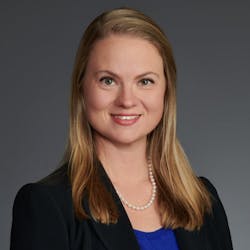
Lauren Saidel-Baker is an economist and senior consulting speaker at ITR Economics, which is part of accounting and advisory firm Crowe. She has been with ITR since 2017 and works with small businesses, trade associations and Fortune 500 companies in a range of industries.
With a tumultuous and topsy-turvy 2025 nearing its end, Saidel-Baker recently sat down with ExecutiveEDGE’s Geert De Lombaerde to talk about best practices when it comes to planning ahead as well as the economic factors she’s watching most closely as we all prepare for 2026. Here, lightly edited for clarity and brevity, are excerpts from that conversation.
De Lombaerde: Let’s start at a high level. How are you thinking about the macro picture as we get ready for 2026?
Saidel-Baker: We are expecting growth ahead. We do not see a recession; we think growth is coming. But this growth cycle into 2026 is going to be much more muted and have much lower growth rate and a slow momentum build. This won’t just be, “We turn things on and pick up.” It’s going to be a general, gradual ramp-up.
So that feels very different than the supply-chain problems that we saw the last growth cycle. I think the big problem is almost our human short-term memory. “That is what a growth cycle felt like to me. So I need to do the same things, I need to go to the same playbook this time around.” That’s really going to be a mistake.
De Lombaerde: You mentioned the supply chain snarls during and after COVID. We dealt with those crises and it’s all about tariffs now. It seems businesses have to have more scenario plans than before to take into account disruptions like those. Is that a fair statement?
Saidel-Baker: I hesitate at “scenario plans” because so many things like COVID, like tariffs this time around, there was some foreshadowing, right? Everyone knew Trump was pro-tariff.
I don’t think it’s scenario planning so much as it is flexibility. It’s about knowing how to make those pivots. At ITR, we are very business cycle-focused and so we do long-term planning that looks through the noise. There are actually longer-term drivers that are driving us now absent COVID, right? That was a bigger shock but generally it moves with the cycle.
So it’s a balance. We don’t want you being so reactionary that you’re losing every plan you put in place. Usually, that is going to be too much, right? Too stark of a change. But maybe it’s still something along the lines of, “I know what my demand will be. I know what my inventory position needs to be. I know how many people I’ve hired and need to train up to be efficient. But alright, tariffs are the thing. Now maybe I have a tariff strategy. Can I look at different sourcing?”
I think it’s staying with the strategic vision but making the tactical moves within that lane.
De Lombaerde: Does needing to deal with a greater number of individual elements than before in building that flexibility mean that companies—the ones that get it right—are starting their process earlier in the year?
Saidel-Baker: I’ve been seeing that, yes. Again, it’s about identifying those top drivers. Labor availability: That is a challenge for every manufacturer I work with. They say, “I just can’t hire a CNC machine operator. They do not exist right now. So what do I do instead?” And the big one that we’re worried about right now is margin compression. We see inflation coming back. We really think this is the turning point and inflation will be building, not continuing downward in the future.


So within that, there are different strategies. “Alright, I need to watch my own pricing strategy. Do I do one big price increase or is that going to alienate my customers? Maybe I do several step-ups. I need to watch my own cost. Where am I sourcing? Are tariffs part of that issue? Is there a different model I can adopt, a good-better-best model, so that if my own customers are more price-sensitive, I can keep them in my ecosystem?”
Maybe you don’t need the catalog model, you just need slightly less. There are a lot of strategies that all come within that. Watch your margins and be laser-focused on the bottom-line objective.
De Lombaerde: I want to be careful using these words but is it easier or simpler knowing those big factors because they make it clearer what your priorities ought to be?
Saidel-Baker: Depending on which industry you’re in, this is a moderate growth cycle at best so this isn’t the rising tide lifting all ships. So I don’t want to say it’s easier. I think it is fairly straightforward if you have that that plan in place. But it’s also a time that you can really differentiate your business from others.
De Lombaerde: Which part of the planning process do you think leadership teams struggle with most? Is it sales forecasting because they have more control over costs? How does that break down when you when you sit across from them?
Saidel-Baker: The first one is removing sentiment, right? Sentiment is very backward-looking. If I grew 5% last year and you’re telling me I’m going to contract this year, that’s where I say, “Oh, really? I don’t feel it. I still feel good.”
One of the big ones for me right now is just where people run into actual capacity limitations. Again, we do see growth going forward. If you’re already as busy as you’ve ever been, where does that capacity come from? It’s that balance point of, “Do I need to make capacity investments to keep up or do I maybe stretch the backlog a little bit more? How can I get away with that without losing the business? How long will this growth cycle persist that that investment would be worth it?”
And the biggest one on capacity is actually people. As much as we hear about the labor market loosening and weakening and the Federal Reserve cutting rates to forestall the decline in the labor market, it is still hard to hire for key roles. So then the question is, “Do I go out and hire someone? How, first of all, do I find that right person? They’re probably coming at a higher cost basis so I need to really, really budget carefully for talent. Or do I invest in some automation? Some technology that can make my existing workforce more efficient. What is that break-even point? It’s not always clear.”
There’s so much data out there that almost everyone can find something that correlates to them. That’s giving them that forward-looking information, that ability to plan based on actual economic events that have already happened.
De Lombaerde: Thinking about larger organizations versus smaller ones, has the gap in their capability for planning widened?
Saidel-Baker: It certainly is a different type of conversation talking with a small business versus someone who maybe is more intimately familiar with management styles or the running of a business. But I don’t think that has to be a permanent roadblock, right? These folks can source different information from us or from other groups and they can be just as well set up for success.
Sometimes, we actually do see the big guys are a little bit too stuck in their ways so they feel the sentiment. They feel right, they get the reports up from various sales channels but aren’t in the weeds on them. If we’re saying, “Hey, your market won’t support this level of growth. That’s a warning sign,” sometimes I get some pushback.
So I don’t think it’s a permanent roadblock to be a smaller company. I do think it’s a stylistic difference and those are fun for me. Some of my favorite relationships are the guy who just knows this product and he’ll go off on some chemical input for it. And I learn a lot but I can then bring the data to the conversation, which is fun for me.
De Lombaerde: A lot of times, leaders of smaller companies know what they don’t know and will put up their hands and say, “OK, what do you have for us?”
Saidel-Baker: Absolutely. And there’s so much data out there that almost everyone can find something that correlates to them, right? That’s giving them that forward-looking information, that ability to plan based on actual economic events that have already happened. It doesn’t just have to be a forecast with guesswork and assumptions. There is a hard leading indicator.
De Lombaerde: And those correlations can stop you from making a mistake. That’s the most important thing, right? You may not get it totally right but you’re not going to get it totally wrong.
Saidel-Baker: Exactly. You won’t be just blindly trekking forward.
About the Author
 Geert De Lombaerde
Geert De Lombaerde
Contributor
A native of Belgium, Geert De Lombaerde joined EndeavorB2B in September 2021 to cover public companies, markets, and economic trends primarily for IndustryWeek, FleetOwner, Oil & Gas Journal, T&D World, and Healthcare Innovation. His work focuses on strategy, leadership, capital spending, and mergers and acquisitions, and he also works with Endeavor Business Intelligence on surveys and data projects.
Geert has been in business journalism since the mid-1990s. With a degree in journalism from the University of Missouri, he began his reporting career at the Business Courier in Cincinnati, initially covering retail and the courts before shifting to banking, insurance, and investing. He later was managing editor and editor of the Nashville Business Journal before being named editor of the Nashville Post in 2008. He led a team that helped grow the Post's online traffic by an average of more than 15% annually before joining Endeavor.
 Resources
Quiz
Your Competitive Edge, DeliveredMake smart decisions faster with ExecutiveEDGE’s weekly newsletter. It delivers leadership insights, economic trends, and forward-thinking strategies. Gain perspectives from today’s top business minds and stay informed on innovations shaping tomorrow’s business landscape.