Key Highlights
- Cross-training employees and formal workforce resilience programs are crucial both for operational redundancy and efficiency.
- Investments aiming to improve resilience should prioritize cybersecurity, talent development, real-time risk analytics, and supply chain continuity.
- Building resilience requires involvement from all parts of the enterprise and set clear and measurable targets.

The economics and business annals of the first half of the 2020s will feature plenty of buzzwords. Remember the unprecedented rise in our use of “unprecedented?” Of course, “AI” and “hyperscalers” will be well represented. As will “uncertainty,” “tariffs” and “transitory”—the last of those an adjective many pros and commentators are now quite wary of applying to anything that is, in fact, quite impermanent.
Also prominent on that list: Resilience. The economy as a whole has been resilient in the face of a pandemic and supply-chain shocks. Consumers have been resilient despite higher prices and a job market that this year started to wobble.
And businesses? They, too, have shown resilience in digesting COVID, the wave of inflation that followed and the more recent upheaval of the United States’ trade policies, among other things. Management teams have tweaked their strategies, trimmed or redirected spending and vetted their processes and partners.
But is all that actually building resilience or simply cutting costs?
The professionals at Grant Thornton this summer set out to answer that question as well as more clearly define what resilience means to Corporate America. After surveying 550 business leaders to get that answer, they also established a clear link between an organization’s resilience and its profitability—even if that means spending a little more in some places.
First, here’s how the executives polled by Grant Thornton broadly defined resilience: The ability to maintain core operations under stress or disruption with minimal impact to customers while continuously learning to improve future responses. Breaking that statement into its components leads to the following priorities leaders should keep in mind when framing their organizations’ work on resilience.
Crosstrain your people
A pandemic, a regional internet outage or a similar disruption will sideline a potentially significant portion of your workforce. Have you properly cross-trained your teams to pick up the baton from those who temporarily can’t do their jobs? Grant Thornton experts say that can take the form of shadowing peers, having junior employees rotate through several departments and setting up more formal education programs with clear goals and skill milestones. The last of those is becoming especially important when it comes to effectively using artificial intelligence and other newer technological tools.
Doing these things, which along the way also build a bench of future leaders, also pays off in times without major disruption: Two-thirds of Grant Thornton respondents who rate their companies as more efficient than their peers have formal workforce resilience programs. Among executives who say their organizations’ efficiency lags peers’, just 30% have such talent initiatives.
Another benefit to having formal training is that it helps eliminate what John Carrier and other professors in the MIT Sloan Executive Education program call “the hidden factory,” the operational tweaks and changes people develop that deviate from how things are supposed to work. Cross-training builds consistency and flushes out “the flaws and annoyances” of such a hidden factory, improving a team’s capacity for redundancy.
Spend smartly
Building resilience calls for greater investment in certain areas but Jen Morelli, a partner in the business consulting group of Grant Thornton, said on a December webcast that improving workforce resilience should aim to over time have teams be better with less rather than do more with less. And while cutting costs remains a corporate must with several GDP models putting growth today and in the first quarter around 2%, the broader aim in controlling spending and targeted investments should be to embed greater optionality.
A resilience reading list
For more resources on building resilience, consider these reports.
- "Efficiency starts with resilience" from Grant Thornton
- "How to build organizational resilience" from MIT Sloan Executive Education
- "Reducing risks and building on strengths," a nuts-and-bolts guide from the U.S. Small Business Administration
Not surprisingly, strengthening cybersecurity protections ranks first by a clear margin. But workforce and talent projects are a clear No. 2 priority and centered around adapting to the growing roles of AI and automation in daily workflows.
Grouped relatively tightly behind those top priorities are:
- Leveraging real-time risk analytics
- Strengthening supply-chain continuity
- Embedding compliance into governance
- Scenario planning and simulating crises
Involve the enterprise
An eyebrow-raising stat in consulting firm PwC’s 28th Annual Global CEO survey published earlier this year was that 42% of business leaders think they need “significantly change” their business models over the next decade to remain relevant—and resilient—in their markets. Such overhauls can’t be realized from the corner office but need involvement from every part of the enterprise. Resilience is a team sport.
Grant Thornton’s Morelli and fellow partner Jonathan Eaton said boards need to be engaged in defining risks and outlining a strategic path to respond to them. From the ground up, teams should be examining their processes and plugging gaps where they find them. And while improving resilience goes well beyond risk management, it serves teams well to involve their colleagues from compliance in that work.
“You want your risk management leaders involved so you can see the potential pitfalls and understand where you should examine your risks along the way and decide proactively how to lead the response,” Eaton said.
Eaton and his colleagues say that being truly strategic about building resilience—including by identifying and tracking key indicators—will help leaders lose the feeling that investments are being made reactively and piecemeal and are thus hard to measure. Doing things scattershot, they write, creates “a perception of chronic scarcity, even when dollars are being spent.”
When to start this work if you haven’t yet? Yesterday, if possible. Consider that the PwC team says overhauling a business model is journey of three to five years. And in this decade of permacrisis—another candidate for 2020s buzzword bingo, perhaps?—it seems a fair bet that we’ll soon be facing another, ahem, unprecedented situation or two.
About the Author
 Geert De Lombaerde
Geert De Lombaerde
Contributor
A native of Belgium, Geert De Lombaerde joined EndeavorB2B in September 2021 to cover public companies, markets, and economic trends primarily for IndustryWeek, FleetOwner, Oil & Gas Journal, T&D World, and Healthcare Innovation. His work focuses on strategy, leadership, capital spending, and mergers and acquisitions, and he also works with Endeavor Business Intelligence on surveys and data projects.
Geert has been in business journalism since the mid-1990s. With a degree in journalism from the University of Missouri, he began his reporting career at the Business Courier in Cincinnati, initially covering retail and the courts before shifting to banking, insurance, and investing. He later was managing editor and editor of the Nashville Business Journal before being named editor of the Nashville Post in 2008. He led a team that helped grow the Post's online traffic by an average of more than 15% annually before joining Endeavor.
 Resources
Quiz
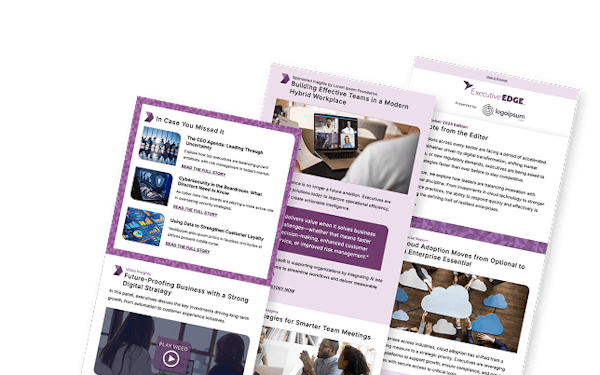
Your Competitive Edge, DeliveredMake smart decisions faster with ExecutiveEDGE’s weekly newsletter. It delivers leadership insights, economic trends, and forward-thinking strategies. Gain perspectives from today’s top business minds and stay informed on innovations shaping tomorrow’s business landscape.