The Rise of the Supermanager: Redefining Leadership in the AI Era
Key Highlights
- AI is transforming the executive role from decision-maker to systems architect, focusing on designing information flows and organizational structures.
- Traditional hierarchies are breaking down as AI enables anyone to generate analysis, making static task assignments obsolete and emphasizing orchestration over control.
- Fluid leadership prioritizes collaboration, context, and momentum, allowing leadership to shift dynamically based on capability and situation.
- The human role is shifting from ego-driven certainty to curiosity, with leaders needing to develop cognitive architecture skills to frame complex problems effectively.
- Next-generation leaders should audit their time, design systems for impact, practice intentional collaboration, and invest in resilience to thrive in an AI-augmented environment.

As artificial intelligence automates more decision support and operational work, executives are being forced to rethink not just how they work, but who they are at work. The traditional executive model — strategy at the top, execution below — is cracking under the weight of real-time data, AI-powered analysis and shrinking decision cycles. In its place, a new leadership archetype is emerging: The supermanager.
This isn’t a productivity upgrade. It’s a role recalibration.
In a conversation with Lucas Root, Ph.D., AI expert, technology advisor, and futurist specializing in behavioral analytics and emerging systems, Root argues that this shift is far deeper than most organizations realize. AI isn’t simply accelerating executive workflows; it’s dismantling long-standing assumptions about authority, expertise and how decisions should move through an organization. As access to insight becomes instantaneous and ubiquitous, Root suggests the executive’s role must evolve from decision-maker-in-chief to systems architect — designing the structures, incentives and information flows that allow humans and intelligent systems to work together at speed and at scale.
From strategic leader to systems architect
AI has collapsed time. Insights that once took days or weeks now arrive in minutes (or nano-seconds). Executives can interrogate data directly, ask complex questions in natural language, and iterate on scenarios in real time.
According to Root, this shift fundamentally alters the executive’s value proposition.
“Information is now ubiquitous and free,” he explains. “What’s valuable isn’t information anymore … it’s curation and architecture.”
In other words, leaders no longer win by knowing more. They win by designing better systems that enable people, data, and AI to work together productively. The supermanager isn’t just a better manager. They are a data architect, now responsible for designing the conditions for better questions, faster decisions and fluid collaboration between humans and intelligent systems.
Hierarchies made sense when decision-making had to move slowly and sequentially. AI flips that logic.
Why the old executive model is breaking
Most leadership structures were built for a world of scarcity: scarcity of data, access and analytical capacity. Hierarchies made sense when decision-making had to move slowly and sequentially. AI flips that logic.
When anyone on a team can generate analysis, synthesize research or model outcomes with the help of AI, rigid task assignment becomes a bottleneck. Static hierarchies delay progress instead of enabling it.
Supermanagers don’t assign work down a chain. They design environments where the right work moves to the right person or system at the right moment.
At its core, supermanagement is a shift from control to orchestration, in which a supermanager:
- Designs decision systems rather than micromanaging tasks
- Creates conditions for talent and AI to "collide" productively
- Focuses on flow, not oversight
- Optimizes for learning speed, not positional authority
This leadership style recognizes a hard truth of the AI era: Specialization is no longer the ultimate advantage — curiosity is.
RECOMMENDED READING FROM LUCAS ROOT, Ph.D.
Lucas recommends the following reading materials for executives who wish to expand their understanding of AI and learning systems and elevate their skills to the supermanagement level.
- “It’s hard to recommend just one book. But The AI Future is a good one that focuses on a cognitive architecture perspective.”
- “The Infinite Game is excellent.” In The Infinite Game, by Simon Sinek, he applies game theory to business, using examples from history and business to show how playing with a long-term, purpose-driven mindset leads to enduring value, unlike a finite mindset that leads to eventual failure.
- "Your Next Five Moves: Master the Art of Business Strategy by Greg Dinkin and Patrick Bet-David is great." This is a business book that teaches entrepreneurs to think strategically like chess grandmasters to achieve ambitious goals, focusing on five key areas: knowing yourself, reasoning, building the right team, scaling strategy, and power plays.
- "I wrote The Forge and the Flow as a ChatGPT prompting guide on how to master ChatGPT, build smarter prompts, and get better results. It’s to be used as a blueprint to move from passive user to prompting architect."
The rise of fluid leadership
One of Root’s most compelling concepts is fluid leadership. This is the idea that leadership should move dynamically based on context and capability, not title. Specifically, AI is democratizing knowledge skills like analysis, synthesis and even language itself. As those skills become table stakes, leadership can no longer remain static.
Instead of working with a single specialist until completion, leadership passes to whoever is best positioned to move the work forward right now.
Fluid leadership prioritizes:
- Collaboration over control
- Context over hierarchy
- Momentum over ownership
In this model, leadership becomes situational, and collaboration becomes a measurable skill rather than a soft one.
The human shift: From ego to curiosity
Ironically, as AI becomes more powerful, human behavior becomes more decisive. Root argues that many traditional leadership models are ego-driven — built around certainty, authority and control. AI quickly exposes the limits of that approach.
“No one person can hold all the knowledge skills that an AI can,” he says. “The shift leaders need to make is from ego to curiosity.”
Curiosity enables better questions. Better questions unlock better AI outputs. And better outputs accelerate smarter decisions. Supermanagers don’t need to have the answers; they need to know how to think multi-dimensionally and how to best structure inquiry.
Tool fluency is table stakes. Cognitive architecture is the edge.
In the near term, executives still need fluency with AI tools. Understanding how to prompt, validate outputs and integrate AI into workflows matters. But that advantage won’t last. What will differentiate leaders over the next three to five years is cognitive architecture: the ability to rapidly build temporary mental structures that help them frame problems, ask precise questions and hold complexity without becoming overwhelmed.
The future-ready executive doesn’t know more. They think better, faster, and with more flexibility.
What This Means for the Next Generation of Leaders
While Gen Z is often criticized for lacking social skills, Root sees opportunity rather than a deficiency. This generation entered adulthood during COVID, armed with high tool fluency but disrupted relational development. Rather than inheriting legacy leadership norms, they are positioned to rebuild leadership models from scratch. They aren’t broken. They’re unburdened.
If organizations create environments that value collaboration, curiosity and fluid leadership, the next generation may adapt faster than anyone expects.
What Executives Should Do Next
For leaders navigating this transition, Root offers clear guidance:
- Audit where your time actually goes.
- Identify tasks driven by ego rather than impact.
- Design systems instead of workflows.
- Practice collaboration intentionally.
- Read deeply and often.
- Invest in personal resilience and health.
As complexity accelerates, leadership sustainability becomes a competitive advantage.
Leadership in an Age of Abundance
AI doesn’t diminish leadership. It demands more of it. The supermanager isn’t replaced by machines. They are revealed by them. In an age of abundance, the executives who thrive will be those who recalibrate their roles — not as commanders of work, but as architects of possibility.
Ready to Unleash Your Inner Supermanager?
Download the Supermanager's AI Toolkit today to get started!
About the Author
 Jess Mand
 Jess Mand
Contributor
Jess Mand is an award-winning communications strategist and founder of INDEMAND Communications, where she helps organizations translate complex ideas into clear, compelling narratives that drive connection and action. She partners with Fortune 500 companies, growth-stage firms, and mission-driven organizations to design communication strategies, content programs, and experiential campaigns that engage employees and elevate leadership messages. Known for her creative storytelling and pragmatic approach, Jess brings a rare blend of strategic insight and human-centered perspective to every project she leads.
 Resources
Quiz
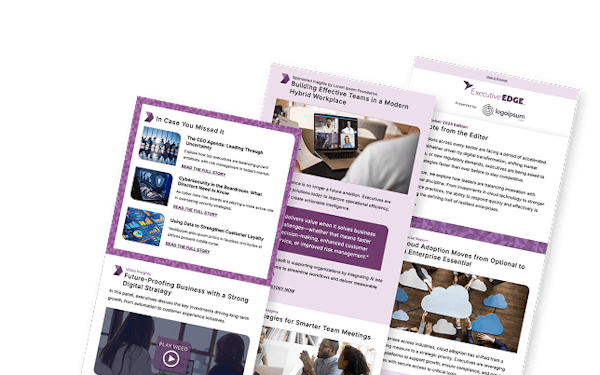
Your Competitive Edge, DeliveredMake smart decisions faster with ExecutiveEDGE’s weekly newsletter. It delivers leadership insights, economic trends, and forward-thinking strategies. Gain perspectives from today’s top business minds and stay informed on innovations shaping tomorrow’s business landscape.