Taking The World View: How to Plan For a Global Economy Moving ‘From Rules to Relationships’
Key Highlights
- Three key opportunities — AI adoption, energy security and regional trade — are identified as pathways to stimulate growth in the 2030s.
- Business strategies should focus on digitalization, diversifying supply chains and adjusting global footprints to mitigate risks and capitalize on new trade alliances.
- Trade infrastructure investments, including port modernization and logistics technology, will shape the future geography of global commerce.

Business leaders have been buffeted in recent years by a series of shocks that have tested their strategies, plans and teams. While those disruptions have also created growth industries and company-level opportunities, their global economic impact has been dampening and is likely to endure for several more years.
The Trump administration’s efforts to rewire many of the economic relationships the United States has with other parts of the world aren’t happening in a vacuum. And while the U.S. economy is still viewed as more dynamic and resilient than many others in the developed world, it’s not isolated from the challenges facing various parts of the globe. As C-suites start to frame plans for 2027, they need to account for the possibility that the bumpy ride the world has been on since early 2020 could last longer still.
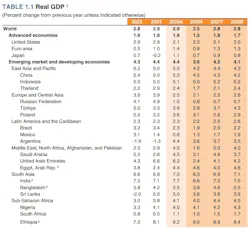
In their new Global Economic Prospects report, World Bank researchers said they see global growth slowing to 2.5% this year, which will be the slowest pace since the pandemic, before ticking up to an average of 2.8% in 2027 and 2028. For the euro area and Japan, a big growth rebound isn’t expected, though, with growth forecast to stay around 1% in the coming years. World Bank analysts think China’s GDP growth will top 4%.
 boardroom_51218569_rawpixelimages_dreamstime
 This is a flashing red emergency light that is isolated on white.
 Empty board room, blue tone, business concept
But for countries the institution calls emerging-market and developing economies, however, growth this year is forecast to be just 0.2%. As Indermit Gill, chief economist at the World Bank, wrote in his 2025 mid-year update, “the poorest countries will suffer the most” from conflict and trade discord. And while the World Bank expect growth in these countries to pick up to 5% annually in the next two years, the lasting effects of recent disruptions still mean that their overall output is “projected to be about 4% lower by the end of 2028 than envisaged in January.”
And yet: Gill wrote that “three pockets of opportunity” are on the horizon that, if capitalized on, could set the global economy on a course for strong growth in the 2030s:
- The well-managed adoption of artificial intelligence, he said, will lift productivity rates.
- Greater energy security, including through higher adoption of clean energy sources, will create jobs and make economies more resilient.
- The third is regional trade, which is growing, changing and creating new opportunities.
A new report by the Dubai Multi Commodities Centre, a free-trade zone set up by the emirate’s government in 2002, also points to the AI boom as a crucial factor in the changing nature of economic growth around the world. AI investments, its authors said, mean growth in services has grown to nearly double that of merchandise trade.
But the AI boom can’t prevent future disruptions. And instability — be it from tariffs, hot wars, geopolitical tension more broadly, or energy and supply-chain shocks — demands action of some sort from business leaders. There’s never a good time to have your strategy dictated to you, but today’s environment calls for an even more deliberate approach that incorporates the major changes we’re seeing happening in near-real time.
So let’s zoom out and try to take stock of the global environment as a way to help set the table for 2027 planning.
Growth isn’t as certain
The DMCC’s recent research, entitled “Future of Trade 2026,” was based primarily on 12 roundtable discussions held around the world with more than 200 business executives, investors and other experts. It makes for sobering reading on how rough many leaders think the path forward will not be: Asked about which of three scenarios they think is most likely for global trade through 2028, a mere 4% chose the best-case scenario highlighted by more constructive geopolitics, above-average growth and inflation coming under control.
By contrast, more than 80% say the most likely scenario for the medium term is a baseline case that comprises modest growth, sticky inflation and on-and-off global tension and conflict. In addition, a mere 5% expect strong growth in trade – with the silver lining being that only 9% see overall trade volume dropping in the next one to three years.
“That number is this report’s most telling finding,” the report’s authors said of the 4% picking the best-case outcome. “Businesses are not planning for a recovery to pre-disruption norms. They are building for a world in which disruption is the norm.”
In short: Broad-based growth isn’t a given and shocks can come from many places. For companies gathered by the DMCC team, the playbook to handle that looks like this:
- 32% are speeding up the digitalization of their operations so that they can reduce their exposure to disruption
- The same share of respondents said they’re beefing up their compliance and sanctions screening work
- 30% said they’re reducing their reliance on single-country sourcing
The higher level of uncertainty and the move, as the DMCC team put it, “from rules to relationships,” means costs are also climbing. But these investments will have a payoff.
“We are moving towards not only regionalization, but almost a friendlization of supply chains,” one Jakarta roundtable participant said. “Not necessarily the most efficient, but actually the best way to allocate capital.”
Time to study the new map
More than four out of five leaders who chatted around the DMCC’s tables said they expect new trade alliances or corridors to form in the coming years. Fewer than 20% think the globalized, multilateral system that was dominant for decades will be the top dog in three years. Instead, nearly 55% said that regional and bloc-based systems will take over.
A map being redrawn means a handful of players have the chance to cement their status as so-called “middle powers” that occupy key places in new trade networks. India is the most prominent example, but Singapore, South Africa and parts of South America also fit the bill. (The United Arab Emirates can also stake a claim, but the Iran war showed how its geography can also be a detriment.)
It’s worth noting that the move toward regional trade blocs isn’t a new development. The World Bank’s report pointed out that such deals have grown in number from about 300 in 2020 to almost 400 today: “Collectively, these agreements now account for 60 percent of global trade, up from 40 percent in 1990.”
For company executives, such changes present opportunities to explore new markets. Miha Hribernik, Deutsche Bank’s chief Asia geopolitical strategist, told the DMCC report’s authors that the world’s economic system remains interconnected despite all the obstacles it’s had to overcome.
“But it is the nature of this globalization that’s changing constantly, and it’s requiring companies to be agile in the face of new trade rules and shifting geopolitics,” he said.
One factor worth extra attention from executives contemplating a new or different international push is the depth of trade infrastructure in various parts of the world. Yes, that means energy and grid equipment as well as data centers. But the DMCC said it also includes modernizing ports, upgrading the technology underpinning logistics and safeguarding finance and other critical networks.
“The investment being made in trade infrastructure today will determine the geography of global commerce for the coming decades,” the DMCC report said.
A headline from June 16 speaks to this dynamic: Infrastructure investment firm I Squared Capital said both it and the U.S. International Development Finance Corp. will commit $1.5 billion to set up a venture “to address [energy infrastructure] bottlenecks and support more secure, reliable and affordable energy systems across the Indo-Pacific.”
How to thrive
For business leaders looking to grow globally, the changing landscape doesn’t come without risks. But to increase your chances of success in 2027 and beyond, here are a few factors to keep in mind:
Invest in reducing friction: That could mean by adopting technology more generally, as is evidenced by the forecast that companies will install more than 700,000 industrial robots in 2028, about two-thirds more than in 2018. It also means putting AI tools to work for you when it comes to forecasting, planning and analyzing risk.
Rethink and remake your supply chain to lower your risk profile: For many firms, that means focusing on energy supply and bringing more renewables into the mix. For others, it’s primarily about diversifying the sources of your inputs.
Consider adjusting your global footprint: Be it for manufacturing, sales or other functions, are your teams in the right spots and well-positioned for long-term trends? Consider that the DMCC report notes that trade between Southern hemisphere nations now accounts for 35% of the world’s total. “The center of gravity in global consumer demand is shifting decisively towards emerging markets, and the trade flows, logistics networks and brand strategies of businesses will need to be increasingly recalibrated to meet that reality.”
Embrace the idea that doubt looks pretty permanent: Strategic and operational agility is becoming more important by the day. As the writers of the DMCC report put it when discussing trade measures: “What businesses can plan around is not the tariff rate, but the certainty that the rate will keep moving.”
About the Author
 Geert De Lombaerde
Geert De Lombaerde
Contributor
A native of Belgium, Geert De Lombaerde joined EndeavorB2B in September 2021 to cover public companies, markets, and economic trends primarily for IndustryWeek, FleetOwner, Oil & Gas Journal, T&D World, and Healthcare Innovation. His work focuses on strategy, leadership, capital spending, and mergers and acquisitions, and he also works with Endeavor Business Intelligence on surveys and data projects.
Geert has been in business journalism since the mid-1990s. With a degree in journalism from the University of Missouri, he began his reporting career at the Business Courier in Cincinnati, initially covering retail and the courts before shifting to banking, insurance, and investing. He later was managing editor and editor of the Nashville Business Journal before being named editor of the Nashville Post in 2008. He led a team that helped grow the Post's online traffic by an average of more than 15% annually before joining Endeavor.
 Resources
Quiz
Your Competitive Edge, DeliveredMake smart decisions faster with ExecutiveEDGE’s weekly newsletter. It delivers leadership insights, economic trends, and forward-thinking strategies. Gain perspectives from today’s top business minds and stay informed on innovations shaping tomorrow’s business landscape.