How Executive Leaders Can Build Better Forecasts Amid Ongoing Uncertainty
Key Highlights
- Forecasting now must account for rapid changes in tariffs, geopolitical events and demand shifts, making traditional models less reliable.
- External disruptions can cause forecasts to become outdated quickly, requiring companies to stay agile and adjust plans frequently.
- Building close relationships with suppliers and visiting their operations can provide early warning signs of potential supply chain issues.
- Regularly rechecking assumptions and setting clear triggers for action help organizations respond proactively to market changes.
- Analyzing pipeline data and understanding the impact of large deals or delays prevents skewed forecasts and supports better decision-making.

Forecasting has always been part science and part crystal ball, with a good dose of human judgment added in. It’s also been something of a crapshoot, with some forecasts hitting the mark, some missing it and others falling somewhere in the workable middle.
Even with that built-in margin for error, those forecasts were based on a fairly stable set of assumptions. Sure, costs changed, demand shifted, geopolitical events emerged and suppliers missed deadlines, but most of those shifts happened individually, giving companies some room to adjust and retrench.
Now tariffs can change costs overnight, geopolitical conflicts can cut off supply and customers can delay spending with little warning, sometimes all at once. Forecasts now have to account for more outside variables, and any one of them can knock the numbers off course.
43% of U.S. CEOs say uncertainty is the external factor most likely to hurt their businesses this year.
Tariffs and supply disruptions can quickly upend business forecasts
Executives are concerned. According to The Conference Board’s most recent C-Suite Outlook, 43% of U.S. CEOs say uncertainty is the external factor most likely to hurt their businesses this year. Nearly 47% expect supply chain disruptions to have a negative impact, 30% say tariffs were one of their biggest external concerns and 35% are worried about an economic downturn.
Any one of these disruptions can upend a B2B organization’s forecast by:
- Turning yesterday’s quote into today’s loss. A manufacturer gets hit with an unexpected import tariff, and products it’s already quoted to customers suddenly cost 25% more to produce. It has to absorb the increase, go back to the customer with a higher price or risk losing money on the order.
- Leaving booked orders unfilled. A distributor can’t get enough inventory from a key supplier after a port closure, a geopolitical conflict or a raw material shortage. The demand is there, and the orders are booked, but the company can’t get the products it needs to fill them on time.
- Pushing expected revenue into the next quarter. A services company adds people and resources based on the sales already in its pipeline; then customers delay projects, freeze spending or redirect their budgets. The anticipated revenue gets pushed into another quarter, but payroll and other expenses don’t stop.
In all three of these scenarios, the original forecast becomes outdated quickly. The demand, orders and customer interest may still be there, but the timing and costs have changed enough to send everyone back to the forecasting drawing board.
Shorter forecasting horizons help companies manage uncertainty
Companies across all industries are dealing with more uncertainty right now, and the curveballs just keep coming. Just when one issue is resolved (e.g., a tariff goes away, a dustup overseas settles down or a key supplier gets its supply chain back on track), five more pop up in its place.

As a small manufacturer of custom battery-charging equipment and power-management systems, Energy Access, Inc., in Indianapolis, has seen its share of disruptions over the last couple of years. The company makes products such as embedded power systems, desktop and wall-plug chargers, and uninterruptible power supplies in a low-volume, high-mix environment.
With customer demand spread across medical, military, test and measurement, public safety and other markets, forecasting gets complicated quickly. Right now, the manufacturer can only see so far ahead. “I feel pretty good about the next four to six months,” says Josh Renicker, COO. “Beyond six months, literally anything could happen.”
Tariff changes can alter costs while shipments are in transit
Even well-thought-out forecasts can be turned on end when tariffs and prices change while an order is in transit. For example, Energy Access sources some plastics and printed circuit board assemblies from Southeast Asia, and those products can spend six or more weeks on the water.
A shipment that made financial sense when it left the port may cost much more by the time it arrives, and the company has to pay the duties. In some cases, air shipping has become the better option, even with its higher upfront costs. “You’re almost better to air everything in,” says Renicker, because an extended ocean voyage gives tariff rates and other variables “more time to change before the shipment arrives.”
 chart_167749008_engdao_wichitpunya_dreamstime
 Midyear Review Text written in torn paper
Energy Access also factors component value into its forecasts. A tariff increase on an inexpensive plastic part may add relatively little to its total cost, making ocean freight a reasonable choice. On the other hand, printed circuit board assemblies cost $50 to $60 each, so the same tariff rate has a much larger impact on the final cost.
To manage that risk, the manufacturer breaks its supply chain into categories and evaluates which components are most exposed. It factors in cost, lead time, oil-price exposure, transportation method and the potential impact of any tariff changes. The company also relies on shorter purchasing windows instead of locking itself into blanket orders that stretch out for a year.
Strong supplier relationships also come into play here. Renicker and his team stay close to the companies they buy from, learning how their operations function and talking through potential problems before they disrupt supply or drive up costs. In return, the manufacturer gets a better sense of what’s happening farther back in its supply chain and any imminent shifts.
Renicker says one of the best things companies can do right now is put some boots on the ground at their suppliers’ locations. “Go meet the people, go to the floor of your supply chain, go see how their operation works,” he says. “There’s nothing like walking on the factory floor and meeting the people who are actually doing the work.”
Four ways executives can build more resilient forecasts
The forecasting crystal ball may be cloudy right now, but executives still have to make good decisions about hiring, spending and revenue targets.

As a former SVP at Cloudinary and VP at Sitecore, B2B SaaS executive Wanda Cadigan managed go-to-market planning, pipeline forecasting and investment decisions through disruptions like COVID and the SaaS market correction.
Here are four forecasting lessons she learned from those experiences:
- Recheck the assumptions behind the annual plan. Conditions can change in the months after a company sets its forecast. “The certainty horizon has shortened,” she says. “Plans built on assumptions made six to nine months ago need regular reevaluation and course corrections when conditions change.”
- Put the pipeline under a microscope. A new enterprise account, customer expansion, partner opportunity and upsell may all appear in the same pipeline report. Each follows a different sales pattern, so examine conversion rates, win rates, deal size, source and deal velocity before deciding which programs to continue or cut back.
- Find out what’s distorting the numbers. One unusually large deal, loss or delayed renewal can skew the forecast. Cadigan recommends looking for the same variance across multiple periods, customer groups or market segments before treating it as evidence of a broader change. A channel that consistently produces higher-than-expected win rates, for example, may warrant more funding.
- Set triggers before the numbers change. Decide now which indicators you’ll watch and when a change in those numbers warrants action. Then make sure everyone agrees on them. “Talk about which indicators you’ll review,” says Cadigan, “how much variance is acceptable and what you’ll do when you hit those thresholds.”
Cadigan also tells executives to watch what’s changing, what’s driving the numbers and how those changes affect hiring, spending and revenue expectations. “Executive teams can’t take a set-it-and-forget-it approach,” she says. “Treat the annual plan as a commitment to the outcome, not a commitment to every tactic or assumption made at the outset of the year.”
About the Author
 Bridget McCrea
Bridget McCrea
Contributor
Bridget McCrea is the award-winning author of Your First Business Blueprint and recipient of a 2025 ASBPE Award of Excellence. Her articles have appeared in Business Insider, Black Enterprise, Hispanic Business, International Business Times and various other publications. With a focus on business, management and technology, Bridget turns real-world insights into content that connects strategy, leadership and results.
 Resources
Quiz
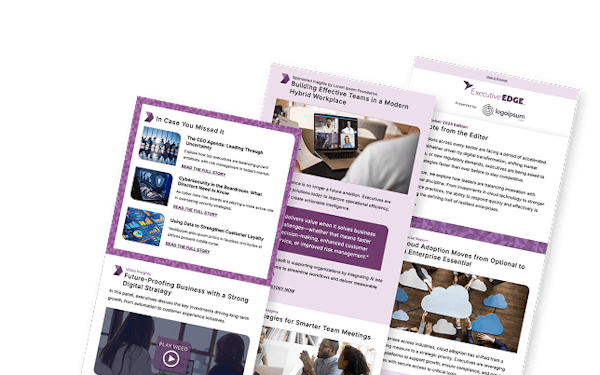
Your Competitive Edge, DeliveredMake smart decisions faster with ExecutiveEDGE’s weekly newsletter. It delivers leadership insights, economic trends, and forward-thinking strategies. Gain perspectives from today’s top business minds and stay informed on innovations shaping tomorrow’s business landscape.