Why Employee Productivity Is a Culture Problem, Not Just a Metric
Key Highlights
- Many employees feel most productive outside of standard hours, indicating traditional metrics may overlook personal work rhythms.
- Clear goal setting and strategic alignment are more impactful for productivity than simply reducing meetings or busy work.
- Tracking productivity can influence behavior, so organizations should work collaboratively across departments to define shared success metrics.
- AI adoption remains limited, partly due to organizational culture and lack of visible leadership support, but it has the potential to significantly boost productivity.
- Ultimately, productivity is deeply tied to organizational culture, motivation and passion, making culture the foundation for sustainable performance improvements.

Prefer to Listen?
Productivity is on every C-suite agenda, but new research from Endeavor Business Intelligence suggests leaders may be measuring the wrong things. Its World Productivity Day survey found that 33% of respondents consider themselves very productive and 44% somewhat productive, while one in five say shifting priorities or unclear direction get in the way. Nearly a quarter also say they do their best work outside standard hours.
In this conversation, ExecutiveEDGE Senior Editor-at-Large Geert De Lombaerde and Paul Mattioli, executive vice president of Endeavor Business Intelligence and Continuing Education, discuss why productivity signals can be misleading and what organizations need to change before AI can deliver on its promise.
Geert De Lombaerde: Productivity is a loaded question. In preparing for this, you mentioned that this report surfaced some artificial productivity signals. What does that mean, and how should leaders think about those signals?
Paul Mattioli: This study really started out almost as a journey to look at redefining productivity. Then we dialed it back a bit to stick with the standards and what organizations have historically looked at as productivity: output and the way employees produce related to their expectations.
The feeling part of it, and how employees actually process that, is where Endeavor Business Intelligence plays really strongly. We like to make it very personal for the end user, as opposed to them talking about the technical side of their job.
It seemed that we were capturing a little bit of the emotion around what productivity really means now, in this generation and the way we work, together or separately, and the ability to turn things around quicker.
I think it was bookended by that other stat you mentioned: I feel most productive early, before everyone is on my inbox or I’m on calls with colleagues or clients, and then after hours, when I can finally take a breath and plow through my piled-up emails. That formerly known as 9-to-5 productivity becomes the bookends when I can do it by myself. So there are some artificial signals in here about what productivity means in this new-world definition of output.
Geert De Lombaerde: People say one of the biggest things to help them be more productive is, “Can you please get rid of the distractions? Can you please get rid of the low-value meetings?” There is a lot of clarity in terms of what people want from their organizations. But there’s a conversation that still needs to be had, it feels like.
Paul Mattioli: Who owns productivity from a management standpoint in the organization? Is it finance? A lot of times it is. Is it sales and sales leadership and marketing, because productivity is reflected in your ability to fill your pipeline, move your pipeline to close and continue that process?
I think it may be muscle memory for people to always point to the amount of meetings preventing them from doing their work. I’m using meetings as a very specific example, but it could be any busy work or filling out your expense reports.
We’ve tried all types of headline-worthy initiatives: meeting-free Friday, no meetings from 12 to 2 every day or every Monday, Wednesday and Friday. The numbers never prove that that’s really the issue with productivity. I think it becomes an easy target.
A lot of productivity, which surfaced in this study as well, was about goal setting and understanding what I’m supposed to be doing every day. I can be as productive as can be with a to-do list that shows me what I’m going to be doing, however long it takes.
I think that’s the problem: There’s this very fuzzy direction right now in terms of setting clear goals and employees feeling that North Star that I’m pointing at every day.
Geert De Lombaerde: We asked people how many organizations actually identify and track productivity explicitly. Thirty percent said they do. More than 40% either said stronger cross-team communication and collaboration or clearer strategic alignment and priorities would generate the most positive impact. There’s a straight line connecting those ideas. Tracking productivity or having clear goals — it’s not one or the other, but it kind of feels like it could be in an organization. Is that fair?
Paul Mattioli: I think it’s super fair. The lines are very blurry at the moment. In meetings with leaders across different market verticals, one thing remains the same: As soon as you start to track it, behavior will change.
If you track something, fundamentally, the definition puts walls up. Some of what I consider productive time may be ideation. Some of it may be time away from my screen. But as soon as someone defines the time that’s being tracked and the expectations of what that means, it starts to become a little bit about behavior change and not about the feeling.



You saw that in the 40% who want cross-team communication when they’re saying meetings are a distraction. The answer, from four out of 10, is to have more cross-team collaboration because there’s that craving for this collective moving something forward. It may mean taking something off the table: not how much do we get done, but how much don’t we do because it’s not going to get to where we need to go.
Leaders really need to be transparent. Let me go to my sales leaders and ask them what they feel productivity looks like. Let me work with my marketing team and my HR group: What is their collective definition of productivity? Let’s all work together on that, and you’ll start to see threads emerge that are org-wide, mission-driven productivity signals.
Geert De Lombaerde: We asked people how AI is helping them be more productive, and only one in eight told us that, so far, it has changed the way they work. Sixty-three percent said they’ve either only experimented with it or aren’t using it at all. Yet AI is this fix-all cure for productivity, supposedly. What needs to change there in your view, or is it just a matter of time?
Paul Mattioli: We’ve done other studies at EBI around AI and adoption, including one specifically on employee confidence. One thing we found was that it’s really demonstrating AI as an asset, an available toolset, and watching how organizations define leadership play with AI, so that it doesn’t feel mysterious.
I talked to a friend who is an AI consultant inside corporate cultures, and the biggest failure for AI implementations is a lack of visible embrace around artificial intelligence. What you see in the results of this survey, all the way down to productivity, is where it gets really personal. My confidence level is different than when I’m asked if I feel more productive, because I feel like there’s an element of guilt there.
It’s sort of like, did you make this from scratch or not? I can turn around a 15-page PowerPoint presentation that would have taken hours. Am I supposed to tell somebody that or not? AI on stage makes AI acceptable to team members, and they should be encouraging each other and showing one another what they’ve done.
I feel like they’re sneaking around a little bit with AI. We have to make sure it doesn’t sound like an AI result, and we all know that you can’t have AI replace the emotion and intent of what you’re doing.
AI has to have a productivity impact, but it should be embraced within organizations. Organizations that are embracing it and making people feel less fearful of it will end up figuring out how AI and productivity work together really well. I believe it will help people redefine productivity, and people will be more proud than they are feeling guilty right now.
Geert De Lombaerde: As we wrap up, the words I’ve circled are freedom, a collective definition of success and confidence. So much of that speaks to me about culture, and having that communication and alignment. Is that the takeaway here? Productivity is culture?
Paul Mattioli: One hundred percent. That’s a personal point of view, but I think we saw it in this data. Is productivity the goal, or is productivity the metric?
Goals are built from and pursued with passion. Productivity is the result of feeling passionate. I really do think it’s about culture.
Otherwise, it becomes yet another dashboard. Whether it’s metrics for sales, finance or productivity, you become another statistic. Productivity is the direct result of motivation and passion. Culture is, to me, the biggest ingredient in making that a successful endeavor for companies.
A survey of 338 professionals found that many employees are working in organizations that lack the clarity and conditions needed to support productivity. The best work often happens outside standard hours, strategic alignment matters more than any tool, and one in four organizations has no way to measure productivity at all.
Download the report and gain a better understanding of where your organization stands.
 Quiz
Quiz
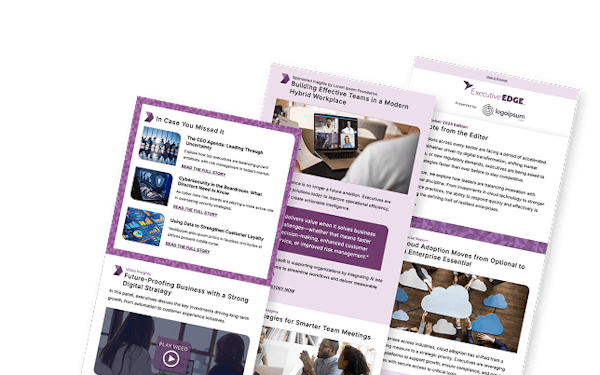
Your Competitive Edge, DeliveredMake smart decisions faster with ExecutiveEDGE’s weekly newsletter. It delivers leadership insights, economic trends, and forward-thinking strategies. Gain perspectives from today’s top business minds and stay informed on innovations shaping tomorrow’s business landscape.