Key Highlights
- Only 32% of surveyed businesses are actively pursuing or planning to pursue tariff refunds, indicating cautious engagement across industries.
- Manufacturing firms show a higher propensity (51%) to seek refunds, reflecting their greater exposure to tariffs and supply chain costs.
- Construction companies are largely hesitant, with 45% choosing not to file.
- The technology and automotive sectors show mixed responses, with some companies exploring refunds but not prioritizing immediate action.
- Overall, industry-specific factors and internal resources heavily influence whether companies pursue tariff refunds, rather than tariff exposure alone.

When the U.S. Supreme Court struck down President Trump’s tariffs on Feb. 20, many major corporations were quick to try to recover their share of the $130 billion in duties collected before the ruling. Even though SCOTUS didn’t directly address refunds, Costco, FedEx, and Bausch + Lomb were among the companies that moved fast, filing lawsuits in the U.S. Court of International Trade seeking repayment of duties collected under tariff policies that had been invalidated.
Your business may not have the legal resources of a multinational shipper or the place where you buy your toilet paper in bulk, but that doesn’t mean the refund opportunity is off the table. This is especially true after a federal judge ruled on March 4 that U.S.-based companies that paid tariffs are legally entitled to refunds.
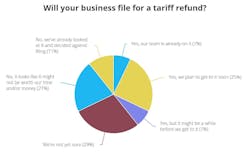
So, the $130 billion question on our minds was whether businesses would actually pursue refunds. Two weeks ago, we asked the ExecutiveEDGE and broader EndeavorB2B audience whether their businesses planned to file for a tariff refund. Here’s what you said:
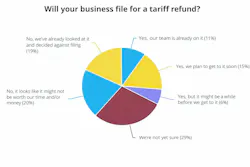
What stands out first is that most respondents are not moving quickly. Of the 430 people who answered this poll, only 32% said their business is already pursuing a refund or plans to do so soon or eventually. In contrast, 29% said they aren’t sure, 20% say it’s not worth it, and 19% have already decided against it. Together, that means nearly seven in 10 respondents are either undecided or unconvinced. This broad uncertainty suggests that the end of emergency tariffs may be less of a clean financial windfall and more of a question of capital and attention allocation for business leaders.
Even among the 32% in the “yes” camp, conviction is limited: Only 11% said that their team is already on it, while the rest said they plan to get to it sooner or later. In other words, many business leaders see a potential opportunity, but relatively few appear to be treating it as an immediate finance, legal or operations priority.
But the top-line results only tell part of the story. Once we break out the data by industry, it becomes clear that tariff exposure alone does not determine whether companies pursue refunds. Rather, sector economics, internal resources and bandwidth, and the perceived payoff appear to matter just as much.
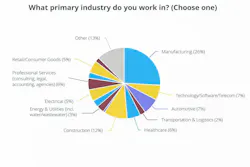
So, let’s get into the individual industries: Manufacturing accounted for the largest share of respondents (26%), followed by construction (12%), with technology/software/telecom, automotive, healthcare and others trailing, as shown in the breakdown in the chart below.
Manufacturing
Manufacturing is arguably among the sectors most exposed to tariffs, materials costs and supply-chain volatility. When we filtered those responses, we found a more action-oriented subgroup than the overall sample. While only 32% of overall respondents said they are already pursuing a refund or expect to do so, that figure rises to 51% among manufacturing leaders. Only 20% of manufacturers have ruled it out compared to 39% of all respondents. At the same time, the sector is not exactly settled: 29% of respondents said they’re still not sure — the same share as the overall sample. This suggests manufacturing leaders are not fully decided so much as more motivated (perhaps financially?) to keep open their refund option.
Construction
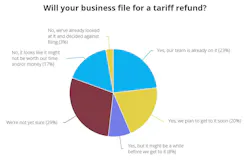
Construction leaders tell a very different story. Despite being another sector heavily exposed to materials costs and supply-chain disruptions, construction leaders appear far more skeptical and less prepared to act than their manufacturing peers. In fact, not a single construction respondent said their team is already filing for a tariff refund, and only 15% said they plan to get it done soon or eventually. Meanwhile, 40% said they are unsure and 45% do not plan to seek a refund. The contrast with manufacturing is striking: One tariff-exposed sector appears to view refunds as a worthwhile opportunity while the other seems much less convinced the effort will pay off.
Technology
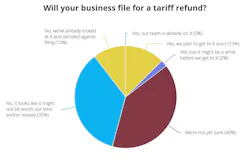
The technology sector lands somewhere between manufacturing’s urgency and construction’s hesitation. While 39% of tech respondents said they are already pursuing a refund or expect to do so, only 7% said their team is already on it. This suggests that many tech companies view refunds as worth exploring but not important enough to warrant immediate internal attention. And once again, uncertainty remains a major theme: 29% said they are still unsure whether they will file.
Automotive
Switching gears to the automotive industry, respondents look more open to filing than the overall sample, with 38% saying they are already pursuing a refund or expect to do so. But what stands out most is that automotive leaders appear more resolved than uncertain. Only 24% said they’re not sure, below the 29% overall, while 38% said they have no plans to file. This suggests many automotive companies may have already assessed the likely payoff and reached a firmer yes-or-no decision than peers in other sectors.
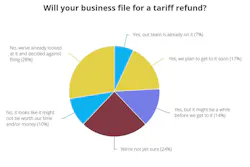
The other industries represented in this poll — including healthcare, energy and utilities, processing, electrical, professional services, and retail/consumer goods — did not generate a large enough response base to support meaningful analysis. Even so, their presence in the broader sample underscores the bigger picture: The end of emergency tariffs is not producing a uniform corporate response. For executives, the question is not simply whether tariff refunds are available, but whether the return justifies the internal time, legal cost and operational effort required to pursue them.
More tariff coverage by industry
Interested in reading more EndeavorB2B coverage on tariffs? Here's a collection of recent articles across industries:
- Supply Chain Connect:
- IndustryWeek:
- Material Handling & Logistics:
- Plastics Machinery & Manufacturing:
- Pharma Manufacturing: Supreme Court rules against Trump’s ‘reciprocal’ tariffs, pharma not directly impacted
- Chemical Processing: Supreme Court Strips Trump's Emergency Tariff Authority
- Contracting Business: Supreme Court Tariff Ruling Offers No Relief for HVACR Industry
- Construction Equipment:
- Contractor: Supreme Court Rules Against Trump Tariffs
- Mass Transit: U.S. Supreme Court strikes down IEEPA tariffs, doesn’t offer refund mechanism
- Wastewater Digest: EPA’s PFAS battle, tariff fallout, and America’s aging water systems
- WaterWorld: Supreme Court rules some Trump tariffs unlawful in 6-3 decision
- Stormwater Solutions: Supreme Court limits presidential tariff authority in major ruling
- Building Design + Construction: Construction materials prices surge in January, driven again by tariffs
- Lightwave: SCOTUS rules against Trump’s tariffs, with broadband providers proceeding with build plans
- Vision Systems Design:
- SecurityInfoWatch:
- FleetMaintenance: Supreme Court limits Trump tariff authority
- FleetOwner:
- Vehicle Service Pros: Hughes:2026: From Crisis Response to Strategic Opportunity
- Ratchet+Wrench: Court Strikes Down Trump-Era Tariffs Imposed Under IEEPA, Citing Lack of Congressional Authorization
- Electrical Marketing: Electrical Market Impact of Supreme Court Decision to Repeal Tariffs Remains Unclear
- Healthcare Purchasing News: AdvaMed Responds to Supreme Court Decision on Tariffs and Future Trade Policy
- AviationPros: NBAA Comments on New Tariff Rulings and Announcements
About the Author
 Abby White
Abby White
Vice President, Content Studio
As Vice President of EndeavorB2B’s Content Studio, Abby leads client-driven custom content programs across 90+ brands and the content strategy for topic and role-based newsletters serving executive audiences. An award-winning journalist with a marketer’s mindset, Abby brings 25 years of experience leading editorial, communications, marketing, and audience-building efforts across industries.
Abby launched her first magazine, Abby’s Top 40, in 1988 and made everyone in her family read it. While attending the University of Illinois, she paid her rent as a professional notetaker, which might explain why she still gets asked to take notes in meetings. Since then, she has held editorial leadership roles at an alt weekly, a newspaper, a luxury lifestyle magazine, a business journal, a music magazine, and regional women’s magazines, developing a sharp writing edge and a conversational tone that resonates with professional audiences.
She expanded into marketing while leading communications for an entertainment industry nonprofit and later drove rebranding and audience-building efforts for an NPR music station. At EndeavorB2B, she has been instrumental in driving editorial excellence, developing scalable content strategies across multiple verticals, and building the foundation for EDGE, the company’s portfolio of executive newsletters.
And if you’re a writer interested in contributing to ExecutiveEDGE, she’s the person you need to (politely) bug.
 Resources
Quiz
Your Competitive Edge, DeliveredMake smart decisions faster with ExecutiveEDGE’s weekly newsletter. It delivers leadership insights, economic trends, and forward-thinking strategies. Gain perspectives from today’s top business minds and stay informed on innovations shaping tomorrow’s business landscape.