Build the Business You Need Next

Listen Here
Does the way your organization operates actually support where you're trying to take it?
In this episode of ExecutiveEDGE, Abby White and Geert De Lombaerde examine three areas where strategy becomes execution: where companies put their money, how organizations respond when assumptions change and whether employees understand what they're actually being asked to accomplish.
The conversation explores why traditional budgeting structures can work against strategic priorities, what resilience looks like when disruption is no longer temporary, and why persistent productivity challenges may have more to do with organizational clarity than employee effort.
Together, these stories raise a bigger question for executives heading into their next planning cycle: Are you optimizing the business you have today, or building the one you'll need next?
What You’ll Learn
- Why traditional departmental budgeting can create friction for cross-functional strategic priorities
- How leaders can think differently about funding capabilities and strategic investments
- Why organizational resilience increasingly requires adaptation rather than simply recovery
- What signals can indicate that the assumptions behind a business plan need to change
- Why unclear priorities and poor alignment can undermine employee productivity
- What new workforce research reveals about productivity, working hours and AI adoption
- How leadership decisions around capital, culture and communication shape execution
Why It Matters
Strategy doesn't end when the executive team agrees on a plan.
It becomes visible in how capital gets allocated, how quickly the organization responds when conditions change and how clearly employees understand the priorities they're working toward.
For executives, that means budgeting, resilience and productivity aren't isolated management challenges. They're all indicators of whether the organization's operating model is aligned with its ambitions — and whether the business is equipped for what comes next.
Episode Resources:
The Strategy Budget: Turning Capital Allocation Into Competitive Advantage, Jess Mand
From Recovery to Growth: How Leaders Can Design Resilient Organizations, Jess Mand
Why Employee Productivity Is a Culture Problem, Not Just a Metric, a
conversation with Geert De Lombaerde and Paul Mattioli
Prefer to read? Here's an excerpt of the podcast transcript:
Abby White: This month we're going to look at three stories that got at a bigger question for business leaders: Does the way your organization operates actually support where you're trying to take it?
The first story we're going to cover is "The Strategy Budget: Turning Capital Allocation into Competitive Advantage," by Jess Mand. Jess challenged the traditional approach of allocating budgets primarily by department. So many of the capabilities companies are investing in now, AI being a pretty obvious example, really cut across those functional boundaries.
Leaders should be thinking more about funding capabilities, not just functions.
Geert De Lombaerde: Yeah. It's an interesting story that Jess pulled together, and one of the ideas is about looking at your business as a portfolio of investments. You have to be very aware of what you're funding and what you're funding it for.
Are you budgeting for the organization that you have or the one that you're aiming to become? That's a huge difference, because if you're just doing it for what you have, then you're just taking care of the silos that already exist, and you're not necessarily paying attention to the bigger strategic goals.
Abby White: Annual budgeting cycles can also become a constraint when technology and market conditions move much faster. I think that's something we've seen a lot over the past several years.
Geert De Lombaerde: Yeah. Trucking and manufacturing companies have talked about things moving on them mid-year, mid-cycle and needing to adjust. So it cuts across industries.
Abby White: If a strategic priority stretches across several departments, like adopting AI and operationalizing it, who really owns that investment?
Geert De Lombaerde: Who's overseeing it, and how is the priority being communicated across different teams and to different parts of the organization? I like the idea mentioned about very deliberate leadership: Does that reflect the goal that you want them all to coalesce toward?
Abby White: Another interesting point that Jess brought up is the idea that maybe companies should be reallocating capital more frequently instead of locking priorities in during an annual budget cycle. Are you seeing companies start to adopt that method?
Geert De Lombaerde: I think you're seeing it being forced on them in some ways. A couple of years ago, you saw it with the disruptions from COVID, inflation and supply chains being completely mucked up.
Now I think they realize that if anything, we can try to dictate that a little bit and be a little bit more ready. The idea that you can make changes during the year — you should be prepared to make changes during the year — is almost becoming embedded in a lot of well-run organizations.
Abby White: A key takeaway for executive leaders is that the budget may be one of the clearest tests of whether a company's stated strategy and its actual priorities match. If you're seeing friction in your 2027 budget planning, I think it's time to take a really hard and honest look at your process.
Geert De Lombaerde: Nothing is sacred. Are you making tweaks, or are you making substantive changes? And that includes when it comes to the actual budgeting process.
Abby White: That takes us into our second story, "From Recovery to Growth: How Leaders Can Design Resilient Organizations." In this article, Jess talked with Paul Thallner, who's the founder of High Peaks Group and author of "Reinventing Resilience."
Paul's argument is that organizations need to move beyond thinking about resilience as the ability to withstand a disruption and return to normal. In an environment where conditions keep changing, resilience increasingly means being able to learn and adjust as the business changes.
Geert De Lombaerde: To me, this is the organizational side of the same coin as the financial side in budgeting. You have to be flexible in where the dollars go, and here you need to be flexible in how you structure your teams and how you have them adjust and listen to the market as the market is changing.
Abby White: Paul also gave a new definition of resilience as really the ability to learn faster than the environment changes.
Geert De Lombaerde: One thing that I really took away from this is the idea of no more hero CEOs. No more omniscient leaders who have all the answers, and the moment something happens, they're ready to make a decision, and everybody follows and gets in line. In the environment that we're in, that doesn't work anymore.
One of the things that Paul talked about was the need to make the decision processes more fluid and not so rigid anymore.
Abby White: We're in the day and age where information from employees closest to customers and operations needs to reach leadership much more quickly, really fast enough to influence decisions.
Geert De Lombaerde: We know disruptions are coming. Are you equipped to absorb and digest and then transmit that information inside your organization quickly, and do you have a process in place that can act on that?
Abby White: Another point that Jess made is that there is a difference between reacting to disruption and recognizing that the business itself has changed. How do you know when you've crossed that line? What should you be looking for as evidence that an old assumption no longer holds? What does organizational resilience look like beyond traditional crisis planning?
Scenario planning can help leaders identify what signals would cause them to change course before a crisis forces the decision.
Geert De Lombaerde: Sometimes it's not about defending the plan, but about recognizing that it needs to change. You can approach it by being stubborn and just push on, or you can say, "We are working with a different environment when it comes to this aspect. We need to act differently as a result."
Abby White: Resilience is becoming less about bouncing back and more about building an organization capable of changing direction without waiting for circumstances to force it.
That takes us into our third story, "Why Employee Productivity is a Culture Problem, Not Just a Metric." This drew on recent research by Endeavor Business Intelligence, which surveyed 338 professionals about productivity. The findings suggest that some of the biggest obstacles to productive work are organizational.
One in five respondents cited shifting priorities or unclear direction as a productivity obstacle. More than 40% of respondents said clearer strategic alignment or stronger cross-team communication could improve productivity. I was surprised that nearly a quarter of respondents said they feel most productive outside traditional working hours.
Geert De Lombaerde: The biggest takeaway for me was that more than 40% said they would like to have clearer alignment with strategic goals and better cross-team communication. Don't just keep doing the work that you have been doing if it's not aligned with the strategic goals anymore.
The fact that people are working outside hours means that that's when they are dedicating their best strategic time to the company. That's kind of the unsettling part if you're a leader, that people are creating extra work in their day to actually get the goals done.
Abby White: We were all promised that AI would make everything easier. What did this survey tell us about AI adoption?
Geert De Lombaerde: It told us that everybody's still playing with it right now. One in eight people told us that AI has changed how they work, but 63% said they were either experimenting with it or not yet using it at all. So there is a huge amount of ground to cover.
AI will make a difference. It's starting to make a difference, but it's super early. Then you can have a good conversation about measuring the right things for productivity.
Abby White: One thing we've been talking about is the idea of tokenmaxxing and having leaderboards and how that got companies in a lot of financial trouble. When you've got people competing to use AI the most without really thinking about what they're using it for, we're not measuring the right things.
Geert De Lombaerde: It goes back to the alignment. If more than 40% of people say they don't feel quite aligned with the strategic goals of the company, there are two options there: Either you are not aligned with the goals of the company, or you haven't been told how the work that you're doing connects to the strategic goals of the company.
So much of this is about culture and what you are discussing as a group, as an organization, and how you are talking about the work that you're doing on a large scale. Culture comes from the top. It has to be embedded deeply for big changes to work, for productivity to feel like it's in a good place.
Abby White: A lot of companies are focused on measuring productivity, again, because of AI. We were promised that if we invest in these things, everyone's going to have a much more efficient workflow. People want to see the results of that. But this research seems to suggest that clarity might be the bigger issue, right?
Geert De Lombaerde: Yeah. Communication is still the big thing, and making sure that people get a sense of why the work they're doing is important in the bigger picture.
Abby White: Before adding another productivity tool or metric, leaders may need to ask whether employees have enough clarity about the company's priorities and the role in achieving them. Think about that messaging, think about the way you're communicating it to your employees, and then everything else comes after that.
Geert De Lombaerde: If you're talking about mid-year off-cycle budget reassessments, and you're talking about resilience exercises because here comes the next disruption, maybe you should be thinking about mid-year off-cycle communication resets that really bring your team back to some sort of a focus. There's no harm in over-communicating where people fit in the organization and the importance of the work that they're doing individually.
Abby White: Walking away from these three stories, one of the big takeaways is strategy doesn't stop once leadership agrees on the plan. It shows up in where the company puts its money, whether the organization can adapt when assumptions change, and whether employees understand what they're being asked to accomplish and what their part in it is.
For leaders who are heading into another planning cycle as 2027 is staring us down, that may be the bigger question worth asking. Does the organization we have today actually support the business we're trying to build next?
*Transcript lightly edited for clarity and brevity
More from ExecutiveEDGE Podcast
About the Author
 Geert De Lombaerde
Geert De Lombaerde
Contributor
A native of Belgium, Geert De Lombaerde joined EndeavorB2B in September 2021 to cover public companies, markets, and economic trends primarily for IndustryWeek, FleetOwner, Oil & Gas Journal, T&D World, and Healthcare Innovation. His work focuses on strategy, leadership, capital spending, and mergers and acquisitions, and he also works with Endeavor Business Intelligence on surveys and data projects.
Geert has been in business journalism since the mid-1990s. With a degree in journalism from the University of Missouri, he began his reporting career at the Business Courier in Cincinnati, initially covering retail and the courts before shifting to banking, insurance, and investing. He later was managing editor and editor of the Nashville Business Journal before being named editor of the Nashville Post in 2008. He led a team that helped grow the Post's online traffic by an average of more than 15% annually before joining Endeavor.
 Abby White
Abby White
Vice President, Content Studio
As Vice President of EndeavorB2B’s Content Studio, Abby leads client-driven custom content programs across 90+ brands and the content strategy for topic and role-based newsletters serving executive audiences. An award-winning journalist with a marketer’s mindset, Abby brings 25 years of experience leading editorial, communications, marketing, and audience-building efforts across industries.
Abby launched her first magazine, Abby’s Top 40, in 1988 and made everyone in her family read it. While attending the University of Illinois, she paid her rent as a professional notetaker, which might explain why she still gets asked to take notes in meetings. Since then, she has held editorial leadership roles at an alt weekly, a newspaper, a luxury lifestyle magazine, a business journal, a music magazine, and regional women’s magazines, developing a sharp writing edge and a conversational tone that resonates with professional audiences.
She expanded into marketing while leading communications for an entertainment industry nonprofit and later drove rebranding and audience-building efforts for an NPR music station. At EndeavorB2B, she has been instrumental in driving editorial excellence, developing scalable content strategies across multiple verticals, and building the foundation for EDGE, the company’s portfolio of executive newsletters.
And if you’re a writer interested in contributing to ExecutiveEDGE, she’s the person you need to (politely) bug.
 Resources
Quiz
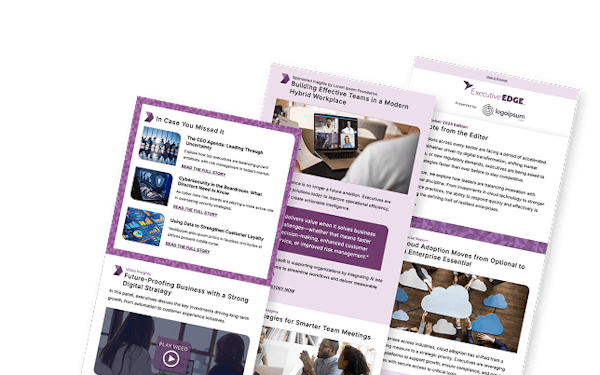
Your Competitive Edge, DeliveredMake smart decisions faster with ExecutiveEDGE’s weekly newsletter. It delivers leadership insights, economic trends, and forward-thinking strategies. Gain perspectives from today’s top business minds and stay informed on innovations shaping tomorrow’s business landscape.