Key Highlights
- Organizations have prioritized efficiency since their big post-pandemic investments. Those strategies are showing up in economic data as quickening productivity growth.
- AI might be starting to play a role in those efforts, but many cost-cutting plans remain focused on tried-and-true measures.
- Executives are expected to double down on efficiency strategies as energy prices rise and geopolitical tensions increase.

Prefer to listen?
Longer company-car leases. Smarter energy use. A tighter rein on software licenses. Implementing lean processes. “Very strict discipline in staffing.” Karin Rådström’s checklist checked just about all the boxes.
The president and CEO of Daimler Truck Holding on March 12 outlined how the parent company of Freightliner, Mercedes-Benz Trucks and other commercial brands will this year squeeze at least $285 million in costs out of its European division. In so doing — and because Daimler Truck is among the last companies with a Dec. 31 fiscal year to report fourth-quarter results — Rådström neatly put a bow on a major theme from this earnings season. Said succinctly: More with less still rules the roost.
The U.S.-Israeli war with Iran could well create an energy-price shock that would rattle increasingly skittish consumers as well as C-suites still fighting several other cost pressures. The conflict has thus quickly changed much of the debate around the U.S. economy. What it won’t change one bit, though, is the relentless focus on efficiency among an untold number of leadership teams. That’s been a top-of-the-list strategic priority since we emerged from the do-what-it-takes days coming out of the COVID-19 pandemic.
Then, executive teams spent what they had to in order to break out of lockdown and regenerate momentum. Companies hired who they needed (and then some) and invested in the equipment and software those people required. It was the price of readmission.
Since at least mid-2022, though, efficiency has been a particularly loud rallying cry among public-company executives looking to show that they’re deserving of investors’ dollars. Their efforts to unwind the distortions of the post-pandemic rebound have started to show up ever more prominently in high-level economic data: Productivity rose 2.8% in the fourth quarter of 2025, its fastest growth in five quarters.
It’s possible early gains from artificial intelligence contributed to that 2.8% rise, but it’s just as likely that most organizations aren’t yet reaping substantive returns from their new tech investments. Instead, old-fashioned, a-little-here-and-a-little-there cost cuts are carrying the load. Here are a few other examples of companies that, like Daimler Truck, are feeding into positive productivity statistics:


 edge_targets_316749463_andrii_yalanskyi_dreamstime
Trucking titan J.B. Hunt Transport Services last spring rolled out a program aimed at cutting at least $100 million in structural costs while upgrading many of the company’s processes. The plan has involved digging into 14 different areas across the business and looking to reinvent, automate, upgrade and generally make things more efficient. Some of that will involve AI, and Andrew Hall, the company’s senior director of finance, recently told a Raymond James conference that executives are “at the point right now where we’re scoping those costs and making sure that we know how much it’s going to cost.”
Still, the J.B. Hunt team has also been cutting costs by cutting headcount. The Arkansas-based company, which has about $12 billion in sales, finished 2025 with 31,750 people on its payroll, a drop of nearly 1,900 people from the end of 2024. Since the end of 2022, when the trucking sector was one of the prime post-COVID examples of all-hands-on-deck and J.B. Hunt added more than 4,000 people, the company’s payroll has steadily shrunk by 5,400.
At California utility PG&E, looking into 14 parts of the company apparently wasn’t a big enough number: The company last year had more than 160 initiatives aimed at reducing waste. Since the beginning of 2023, such efforts have produced cumulative savings of nearly $1.1 billion and let executives raise their long-term goal of operational cost cuts to a range of 2% to 4% from 2%.
“We’re not done yet,” CFO Carolyn Burke told analysts and investors in mid-February. “This is a muscle we’re continuing to strengthen.”
Chris Williamson, chief business economist at S&P Global Market Intelligence, wrote last week that it’s a good bet other companies will double down on strengthening their own muscles now that hostility in the Middle East has erupted into widespread conflict. The early-year surge in economic activity and positive sentiment — which we documented a month ago — just might have run headlong into a geopolitical wall.
“Our global PMI surveys indicated an acceleration of worldwide economic growth prior to the outbreak of the Middle East war, with the expansion hitting the fastest since May 2024. February’s upturn was in fact one of the best seen since the pandemic,” Williamson wrote on LinkedIn. “With the war in the Middle East driving energy costs sharply higher, and fueling further geopolitical uncertainty, the economic environment is likely to place further pressure on companies to seek productivity gains in the coming months.”
Time to tighten those belts. Again.
About the Author
 Geert De Lombaerde
Geert De Lombaerde
Contributor
A native of Belgium, Geert De Lombaerde joined EndeavorB2B in September 2021 to cover public companies, markets, and economic trends primarily for IndustryWeek, FleetOwner, Oil & Gas Journal, T&D World, and Healthcare Innovation. His work focuses on strategy, leadership, capital spending, and mergers and acquisitions, and he also works with Endeavor Business Intelligence on surveys and data projects.
Geert has been in business journalism since the mid-1990s. With a degree in journalism from the University of Missouri, he began his reporting career at the Business Courier in Cincinnati, initially covering retail and the courts before shifting to banking, insurance, and investing. He later was managing editor and editor of the Nashville Business Journal before being named editor of the Nashville Post in 2008. He led a team that helped grow the Post's online traffic by an average of more than 15% annually before joining Endeavor.
 Resources
Quiz
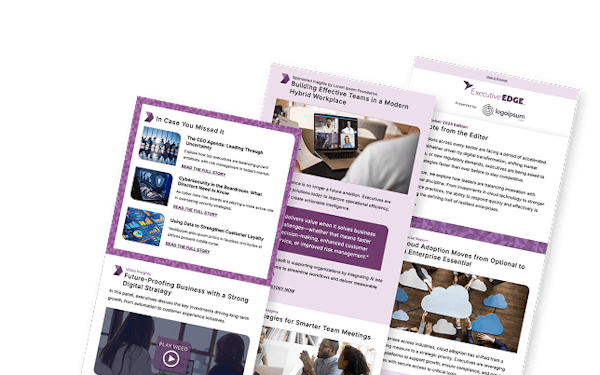
Your Competitive Edge, DeliveredMake smart decisions faster with ExecutiveEDGE’s weekly newsletter. It delivers leadership insights, economic trends, and forward-thinking strategies. Gain perspectives from today’s top business minds and stay informed on innovations shaping tomorrow’s business landscape.