How to Lead With Conviction Instead of Performing Confidence
Key Highlights
- Leaders who project certainty they don't feel can create cultures where employees soften bad news, undermining strategic decisions.
- Organizational environments that punish candor reinforce performed confidence, even among capable leaders.
- Conviction differs from stubbornness in a leader's willingness to change course when evidence no longer supports a decision.
- Executives can encourage more honest leadership by rewarding early problem reporting and inviting dissent.

If you’ve been a leader at any point, there’s a decent chance you’ve had moments where your work and actions diverged from your identity and your values. Glenn Llopis, an entrepreneur, author and advisor to Fortune 500 companies, says it happens a lot in the corporate world, and it can lead executives to fall into a pattern of performing rather than leading, of projecting confidence as they lose touch with their convictions. That disconnect can have consequences beyond the individual executive, influencing how openly employees communicate problems and how effectively organizations make strategic decisions.
In this Q&A with Geert De Lombaerde, Llopis outlines the roots of this dynamic, distinguishes conviction from stubbornness and gives readers — both leaders and the people reporting to them — practical measures to start breaking the habits they might want to leave behind.
If your end-of-year priorities include setting the stage for a more productive, authentic and healthier 2027, this is a great place to start.
De Lombaerde: You say our society has built a generation of leaders “who perform confidence they do not feel.” How did we get here? And were there pivot points along the way?
Llopis: We got here honestly. For most of the last century, organizations scaled by standardizing everything, including people. That standardization was valuable. It made quality repeatable and let companies grow.
But it came with an unspoken deal: Fit the mold, and we’ll take care of you. So people learned to present the version of themselves the system rewarded, and leaders learned to project certainty because certainty is what got promoted.
I see three pivot points. The first was the end of that deal. Once companies could no longer promise security, people kept performing anyway, out of habit and fear. The second was social media, which turned the performance into a full-time job and moved it earlier in life. The editing now starts around 15, long before anyone has a job title.
Find out more about Glenn Llopis at theglennllopis.com and via his sixth and most recent book, Earning Conviction: The Practice That Redirects Leaders from Exhausted to Unshakeable.
The third is happening now. AI makes it possible to sound informed about almost anything in seconds. In Pluralsight’s 2025 AI Skills Report, 91% of C-suite executives admitted to overstating their AI knowledge. This isn’t only a cultural problem. It’s a strategy problem. When confidence is performed, bad news travels up slowly and softened. Strategy reviews get less honest, and investment decisions get made on the version of reality people felt safe presenting.
And employees notice. Korn Ferry recently reported that the share of non-executive employees confident in their senior leaders fell from 68% to 53% in two years.
The practical step: In your next leadership meeting, notice how often anyone says “I don’t know yet.” If the answer is almost never, the room is rewarding performance, and your decisions are paying for it.
How much of this dynamic would you attribute to individuals versus the complex team and organizational dynamics leaders need to steer?
Both, and they feed each other. That’s what makes the pattern so durable. Individuals perform because the room rewards it. The room keeps rewarding it because the people in it keep performing.
A plant manager who knows a line is underperforming softens the update because the last person who brought bad news early was treated as the problem. Everyone in that meeting learns the lesson, and next quarter the update is softer still. Nobody decided to build a culture of performed confidence. It accumulated, one reasonable choice at a time.
The people who report directly into the C-suite sit at the center of this. Every week, they decide whether the truth moves up intact or gets polished on the way. Most of them were never taught that this is one of the most consequential decisions they make.
 Closeup of pointing to a football strategy plan drawn on a virtual screen.

 arrows_2_145304103_christian_horz_dreamstime
 Hand turning a productivity knob. Concept for productivity management.
That’s why I don’t think you can fix this with individual coaching alone. You can help a leader reconnect with what they actually believe. But if they go back into an environment that punishes candor, they’ll return to who they were within a quarter. I’ve seen it happen many times.
The leader’s job is to change both sides at once: to know who they are well enough to lead from it, and to shape an environment where other people can do the same. Every time a senior leader rewards a polished answer over an honest one, they make a decision about culture, whether they mean to or not.
The practical step: The next time someone brings you a problem early, thank them in front of others before you discuss the problem. People watch what happens to the first person who tells the truth.
Looking at the business community today, it doesn’t take long to find big personalities such as Elon Musk or Jensen Huang. Would you say they are leading with conviction?
I’m wary of grading leaders I’ve never worked alongside. A big personality and conviction can look alike from a distance, and only the people closest to a leader really know which one they’re seeing. What I can offer readers is a test they can apply to anyone, including themselves. Conviction holds firm because the evidence still supports it. Stubbornness holds firm because changing course would feel like losing.
So watch what a leader does when they’re wrong. Do they say so and adjust or do they double down to protect the decision? From the inside, the two feel the same. From the outside, the difference shows up in how quickly the organization learns.
A second test: Do the people around them get bigger or smaller? Leaders with real conviction don’t need everyone to think like them. They’re secure enough to surround themselves with people who disagree. Among leaders I’ve interviewed, a healthcare CEO once told me that he refuses to treat standardization and personalization as a trade-off, even though running an institution that size would make it easy to choose one.
A travel executive told me the person who doesn’t fit your culture is often your disruptor, the one challenging the status quo you need challenged. That takes conviction to say and more to act on.
Your book outlines 101 prompts to redirect people. Can you pick out three that are among your favorites and say why?
The three redirects I return to most often are:
The most strategic question isn’t always, “What should we do?” It can be, “What should we stop doing?” I once asked a leadership team with 12 strategic priorities what they would stop doing to make room for them. Silence. One executive finally said, “We never really stop anything.” So we set a rule: For every new priority, name one thing to stop, reduce or delegate. Some “priorities” didn’t survive the test, which told us they were never strategic. For anyone setting investment priorities, that one-to-one ratio is the most honest discipline I know.
You can help a leader reconnect with what they actually believe. But if they go back into an environment that punishes candor, they’ll return to who they were within a quarter.
Courageous leaders don’t just tolerate dissent. They invite it. A leader I coached was shocked when her 360 said she got defensive when challenged. Then we watched a recording of her meeting: Within 30 seconds of a concern being raised, she was explaining why it was wrong. She started answering challenges with, “Tell me more about that concern. What am I not seeing?” Three months later, her team was bringing her problems she never would have heard.
The question isn’t, “What do you want to do?” It’s, “What problem do you want to be known for solving?” This is the one for anyone aspiring to a bigger role. A manager who couldn’t say where she wanted to be in five years lit up when asked what problem bothered her most: It was expertise walking out the door. She built her work around fixing it, and two years later the company created a director role around her.
None of these asks anyone to become a different person. They ask you to close the distance between what you believe and what you do, one practice at a time.
You’ve based this book in part on a portion of your own career “performing” as a successful executive. Looking back, when did you know you were breaking away from that habit and making progress to something healthier?
For the first several years of my career, I performed the successful executive. I projected the competent consultant and kept up a polished image. I succeeded by every measure my organizations cared about and I was depleting myself in the process.
There was no single dramatic moment. The shift came when I changed the question I was asking. I stopped asking, “How do I become better at performing this role?” and started asking, “How do I redirect all the energy I’m spending on performance toward something I can actually sustain?”
The first sign of progress was three words I had avoided for most of my career: “I don’t know.” I used to deflect or try to fake my way through questions I couldn’t answer, because I thought admitting it would cost me authority. When I finally started saying it, in rooms where it felt risky, nobody lost respect for me. People stepped forward with answers I didn’t have.
Another sign came in 2013, when I was on tour for my first book, Earning Serendipity. My father had just passed away, and at the University of Minnesota I talked openly about my grief and what he had taught me, rather than delivering a polished keynote. Someone in that audience later wrote that those stories stayed with them long after the talk ended. That person wrote the foreword to this book.
My father had a phrase for hard moments: “Keep going, son. Keep going.” It took me years to understand he didn’t mean endure. He meant keep believing in who you are, especially when it would be easier to go back to performing.
My advice for anyone still climbing: You don’t have to wait until you’ve arrived to stop performing. The sooner you start, the more of your career you get to spend as yourself.
About the Author
 Geert De Lombaerde
Contributor
A native of Belgium, Geert De Lombaerde joined EndeavorB2B in September 2021 to cover public companies, markets, and economic trends primarily for IndustryWeek, FleetOwner, Oil & Gas Journal, T&D World, and Healthcare Innovation. His work focuses on strategy, leadership, capital spending, and mergers and acquisitions, and he also works with Endeavor Business Intelligence on surveys and data projects.
Geert has been in business journalism since the mid-1990s. With a degree in journalism from the University of Missouri, he began his reporting career at the Business Courier in Cincinnati, initially covering retail and the courts before shifting to banking, insurance, and investing. He later was managing editor and editor of the Nashville Business Journal before being named editor of the Nashville Post in 2008. He led a team that helped grow the Post's online traffic by an average of more than 15% annually before joining Endeavor.
 Resources
Quiz
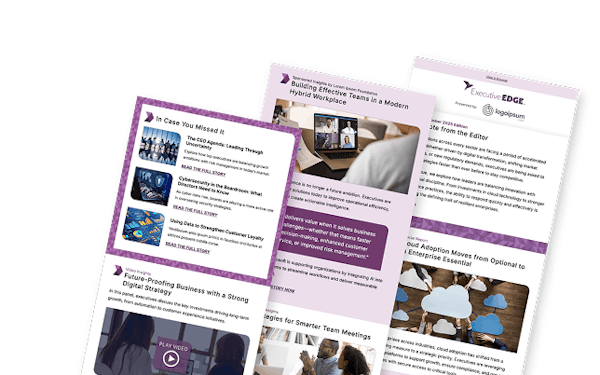
Your Competitive Edge, DeliveredMake smart decisions faster with ExecutiveEDGE’s weekly newsletter. It delivers leadership insights, economic trends, and forward-thinking strategies. Gain perspectives from today’s top business minds and stay informed on innovations shaping tomorrow’s business landscape.