2026 Competitive Landscape: What Should Executives Focus on During Economic Uncertainty?
Key Highlights
- Prioritize strategic planning to build adaptability and resilience, ensuring long-term progress despite short-term disruptions.
- Design scalable and flexible operating systems that can quickly adjust to changing conditions, including scaling up or down as needed.
- Cultivate a strong organizational culture that supports strategic goals and can withstand volatility, acting as the foundation for effective execution.
- Implement clear, consistent and proactive communication strategies to maintain stakeholder trust and manage reputational risks during uncertain times.
- Focus on operational basics as a source of competitive advantage, enabling organizations to navigate headwinds and capitalize on emerging opportunities.

Globally, economic signals remain mixed.
The United States continues to show resilience in key sectors, supported by strong consumer pockets, government investment and ongoing digital transformation. Real U.S. GDP growth estimates for 2026 are a healthy 2.2%, according to Deloitte. At the same time, Europe faces slower growth and industrial recalibration, while Asia navigates a complex balance between export momentum and domestic economic pressure. Interest rates have stabilized, but they remain high enough to limit aggressive expansion, particularly for capital-intensive businesses. Capital is still available, but more selectively, forcing leaders to be more disciplined about where they invest and how they pursue growth.
Geopolitical dynamics continue to reshape how businesses operate. (Honestly, who had Iran on their bingo card in Q1?) Fuel prices, trade policy, tariffs and regional tensions are affecting everything from sourcing strategies to market access. Supply chains are being reconfigured not just for cost efficiency, but for resilience, control and speed. Nearshoring, reshoring and regional diversification are quickly becoming standard practice in more boardrooms.
While we could dissect and “gameplan” each of the scenarios mentioned above, the reality for today’s executive teams remains the same: Operational basics still matter the most.
When the economic outlook is uncertain, go back to operational basics
I have the privilege of working with hundreds of talented operations executives both inside the COO Forum and beyond. They come from large and small companies across numerous industries and levels of operational complexity. This provides me with a unique vantage point on many executive teams and how they are performing amid this year’s headwinds, which brings us to our first point:
Operational Basics #1: Strategic planning is still essential.
Volatility and uncertainty create structural tension inside organizations.
As systems strain, teams escalate issues, and as external pressures increase, the pull of execution becomes relentless. For example, just as Q1 fuel prices were dropping to 10-year lows, companies began to bake lower costs into their business plans for the balance of 2026. Then, overnight, after a few press releases, fuel costs skyrocketed.
Executives may be tempted to throw their hands into the air and wait to see how everything shakes out. However, as we all know, waiting is not an effective strategy. Operations need to build adaptability and resilience into their structures. Without deliberate intervention, strategy does not simply get delayed — it gets erased. Organizations stay busy, but progress slows, even as short-term efficiency improves while long-term resilience quietly weakens. This pattern is playing out in real time across companies where urgency consistently overrides importance.
This tension is familiar to many operations leaders. Early in my career, I found myself pulled into the same cycle. I knew strategic work mattered, but the immediacy of operational issues always took priority. Over time, I became highly effective at responding quickly, solving problems on the fly, and navigating constant pressure. Ironically, that strength became a limitation. The better I became at handling the noise, the less space I created to think beyond it.
Executives must protect strategic planning as a core business discipline, especially when the pressure to stay reactive is strongest.
Operational Basics #2: Build systems that scale up (and down)
The challenge for operations teams is not choosing between strategy and execution; rather, it is designing an operating model that allows both to coexist under pressure.
 edge_instability_408539954_ernest_akayeu_dreamstim
 edge_trimming_tree_214201638_claudio_camilli_dream
 abby0312
In today’s environment, execution excellence depends less on effort and more on structural clarity. Clear ownership, defined decision pathways, useful data and metrics, and systems that scale with complexity matter more than individual heroics. Balance is not achieved through longer hours or better multitasking. It is achieved through design.
That design also needs flexibility. Scaling does not always mean expansion; it can also mean retraction. Is your operating model robust enough to weather an unforeseen storm and scale down efficiently? Can it then adapt quickly enough to scale back up within weeks, or even days? For instance, the SaaS (software-as-a-service) business model completely upended the large enterprise-wide software implementation approach that now allows businesses to experiment with software in smaller, controlled scenarios.
We see the most effective executives rapidly adjust their systems up or down to fit their business’s needs.
Operational Basics #3: Organizational culture matters even more today.
A strategy can look strong on paper and still fail in execution if the organization is not equipped to carry it out. That is why culture should not be treated as a side issue, but as a core operating capability.
Ask yourself: Is your organization built around a culture that drives a clear mission? Can your company culture handle the volatility and uncertainty that defines our current economic climate? How does culture play into the success of your strategies?
In business, as Q1 has already shown, most plans don’t survive long enough to see the light of day or tomorrow’s headlines.
Think of culture as the ship that is built to transport your company. Your strategy sets the direction, course and speed, and determines the cargo or deliverables. Your ship must be sound and able to carry the company along its course. During the journey, you mend the leaks, repair the sails and keep the crew happy.
More simply, culture is nothing more than the accumulation of decisions and actions taken within an organization over time. Executives need to focus on culture more than ever. Why? Strategies require organizational cohesiveness and consistency to be executed effectively.
Culture matters even more when conditions are unstable. I have personally seen wonderfully crafted strategies sink because a company’s culture wasn’t built to carry the load. As executives, we must understand the link between strategy and culture. More importantly, get your culture right before you hit rough seas.
Operational Basics #4: Communicate early, clearly and often.
While clear, specific and timely communication is a basic requirement for any leader, executives must be very intentional in their communication during uncertain times.
As 2026 has already shown, news cycles can sway public opinion in a matter of hours. Companies and industries can quickly find themselves responding to scrutiny, anxiety or reputational pressure. When that happens, executives need to communicate clearly, specifically and consistently with stakeholders, including employees, customers and partners — not just once, but through a consistent campaign that delivers regular updates.
Silence, on the other hand, only creates risk as it makes your stakeholders question whether they can trust you. Trust is easier to preserve than to rebuild, and you do not want to lose your team’s trust or confidence — the collateral damage and effort required to rebuild it can be overwhelming.
To avoid this scenario, your organization should develop a communications plan before you need one. Also, be sure to monitor geopolitical, national and regional developments that could affect confidence, customer relationships or internal morale. In volatile conditions, communication is about stability as much as it is about visibility.
The bottom line
Q1 2026 has already reminded leaders how quickly assumptions can change, and more disruption is likely ahead. But your organization does not have to reflect the chaos around you.
The companies best positioned to perform through uncertainty will be the ones that stay disciplined on the fundamentals: strategic planning, flexible systems, strong culture and clear communication. Because, in this environment, operational basics are not basic at all. They are a competitive advantage.
Fair winds and following seas!
About the Author
 Chuck Orzechowski
Chuck Orzechowski
Contributor
Chuck Orzechowski serves as CEO of the COO Forum®. Since 2004, the COO Forum’s mission has been to support operations executives in achieving more in their business and professional lives. As a peer-based professional development organization, the COO Forum has helped 1000’s of executives navigate the challenges of their roles and improve business outcomes. Over the past 30 years, Chuck has spent most of his career leading operations in a wide variety of industries and company sizes, ranging from start-ups to Fortune 500s. Chuck has a passion for improving operations, scaling businesses, and the professional development of others.
 Resources
Quiz
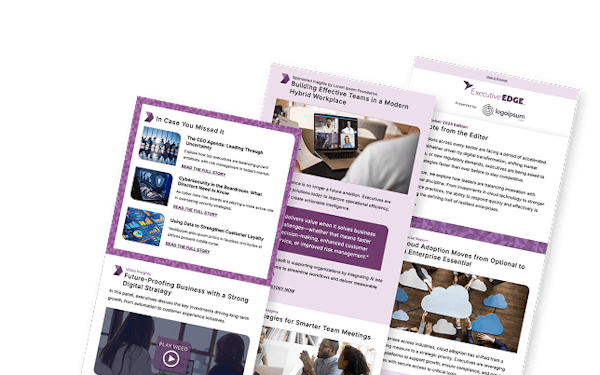
Your Competitive Edge, DeliveredMake smart decisions faster with ExecutiveEDGE’s weekly newsletter. It delivers leadership insights, economic trends, and forward-thinking strategies. Gain perspectives from today’s top business minds and stay informed on innovations shaping tomorrow’s business landscape.