What smart leaders do when uncertainty sticks
What you'll learn
- Why tariff pressure is still forcing leaders to absorb more than they can adapt
- How confident leadership teams are managing through disruption coming from several directions at once
- What executives should focus on when the economy stays uncertain and capital gets more selective
- What boards need to do when a company moves from strain into real distress
- Why AI orchestration is becoming a leadership and governance issue, not just a technology one

Listen Here
In this episode of the ExecutiveEDGE Podcast, Abby White and Geert De Lombaerde unpack the five stories ExecutiveEDGE readers spent the most time with this month and what those choices reveal about the pressures shaping executive decision-making right now. From tariff pressure and layered disruption to board oversight and AI coordination, this conversation is really about what happens when uncertainty stops looking temporary and starts shaping how leaders operate every day.
Prefer to read? Here's an excerpt of the podcast transcript:
Abby White: Today, we’re reviewing the five most-read articles from the past month and looking at not only what they said, but why they resonated with executive leaders. Over the past month, our audience clicked on stories about what leaders do when pressure lingers, absorb tariff costs, manage through layered disruption, sharpen their competitive focus, guide companies through distress and figure out how AI actually works in the real world.
So, Geert, the first story is one of yours: “Tariffs One Year On: Leaders Are Absorbing More Than Adapting, Waiting More Than Acting.” It sounds like there’s a collective frustration among executive leaders right now. Would you describe it that way?
Geert De Lombaerde: I would. Somewhere between frustration and acceptance and shaking fists at skies. This is a story that has had quite a shelf life for us because it’s still not entirely clear what the full picture is, whether it will stay that way or what knock-on effects there might be.
There’s a feeling that executive teams need to react, but they still don’t quite know how because they don’t know what the next 90 days might look like. It creates a lot of uncertainty.
Abby White: Right. We’ve been covering tariffs a lot on ExecutiveEDGE in several ways. We’ve done a survey across our audiences to assess whether leaders are actually going to apply for tariff refunds, how proactive they’re being and whether this is high on their priority list. I think that’s why this keeps rising to the top. Leaders want to see what other leaders are doing.
Geert De Lombaarde: Yes, and there’s a potential price to pay for making a move. One of the things I flagged, going back to the story, is that the biggest response executive teams have made is pushing price.
A lot of the public companies I’m listening to and talking to say they feel good enough about the demand environment that they can push price and not lose too much business. Our survey respondents told a slightly different story. Twenty-eight percent said that pushing price cost them some business, that it drove customers into competitors’ arms.
Every action has a reaction. What’s difficult with the tariff picture is that there are so many actions going on at the same time that it’s hard to draw a line between which reaction is coming from which action and then decide how to adapt. It makes for rough sailing because we still don’t know what the situation is or what all the ramifications are of the actions a C-suite might take.
Abby White: And the fact that we’re still covering this story so much shows this was not a temporary disruption. It’s more of a permanent operating condition now. Leaders need more flexibility, and they need to be ready to pivot, especially when the research shows that even though executives say on earnings calls that they’re pushing price and it’s not affecting them, it is starting to affect their consumers.
Geert De Lombaarde: Yes, and it’s worth noting that the Biden administration kept in place a lot of the tariffs from Trump’s first term. So it’s not a given that if there’s a change in a year and a half or two years during the next presidential cycle, things go back to normal. There may not be a normal the way there was before. The tweaks are going to keep coming.
Abby White: That pressure helps explain the mood for our next story, because even competent leadership teams are managing through more than one problem at a time. This is another one of yours, “Confident C-Suites Face Up to a Multidimensional Disruption.”
Geert De Lombaarde: That phrase came from the team at EY Parthenon. They were talking about the fact that even though we’re dealing now with inflation from the Iran war more recently, tariffs and the supply chain issues from last year, executive teams have been dealing with some sort of disruption for most of this decade.
Going back to COVID and the initial inflation surge, it’s been these rolling waves of disruption. You can’t really get over one without turning the corner and seeing another one. C-suites have become very good at adapting and keeping their strategic plans intact while going with the flow to a certain extent.
Companies have become very good at dealing with disruption. If you look at the macroeconomic data, the economy is doing okay despite all of this. Things are decent. They’re not great. Nobody’s saying GDP growth is going to accelerate dramatically, but we’re right at trend despite everything being up in the air at any given time.
Leadership teams can take something away from that: make a good plan, test it and then go with it, because the underlying economy seems to be doing okay. The demand seems to be there. You just need to make sure you show up for it consistently.
Abby White: That’s the interesting angle. When we think about confidence, we usually think that means optimism, but I don’t think that’s what this is. The past six years have shown that normal has been thrown out the window. We’re all trying to navigate rough waters, and maybe leaders have just become more proficient at figuring out when to wait and when to move. Maybe they have more confidence in their ability to lead through that.
Geert De Lombaarde: There’s a muscle memory there. The exact crisis or mini-crisis may look a little different, but we’ve been there, we’ve done this and we’re going to do it again. Confident leaders can bring that through their whole organizations.
Abby White: It definitely puts it in perspective, and there’s also that acceptance that instability is not going to clear up anytime soon.
That takes us into our next article, by Chuck Orzechowski: “2026 Competitive Landscape: What Should Executives Focus on During Economic Uncertainty?” This one continues that thread. It feels like it takes us from diagnosis to decision-making. We’re all aware there’s uncertainty, but now we’re asking the practical question a COO needs to ask: What matters most right now?
Geert De Lombaarde: Absolutely. Early in his column, Chuck used the word “selective.” He was talking about how growth capital is there, but it’s being more selective. That word is one I hear a lot on conference calls and in other places where leading executives are talking.
Organizations need to know they have a plan and, depending on conditions, they may need to be more selective about it. The best ideas get the capital. With all the disruptions and mini-crises we’ve talked about, it’s a good muscle for an organization to have.
Chuck talks about how good organizations flex up, but they can also flex down in certain situations. Good organizations can do that without giving up more than they absolutely have to. And the overarching strategy is that you can’t just freeze. Chuck makes the point that without deliberate intervention, strategy doesn’t just get delayed; it gets erased. It literally becomes obsolete.
Abby White: We talked about that a lot in our podcast last month: when to take action and what leaders might have waited a little longer on in the past. It tests prioritization, because you have to be selective about what gets attention.
Geert De Lombaarde: Yes, and that idea of prioritization and flexing up and flexing down also depends on having a good company culture and strong communication. To me, those things work together. If your teams know what you’re about and you’ve communicated clearly, then flexing up and flexing down becomes more habitual. It becomes, “We’re doing this, we’re doing that, okay, let’s get to work.” That helps you adapt to what’s being thrown at you.
Abby White: I’m glad you brought that up. When the world is volatile, if employees at least feel like they understand what’s going on internally and understand the company’s direction, that can ease tension and frustration. That communication really matters.
Geert De Lombaarde: Exactly. Any challenge you’re facing is already challenging enough. Don’t let it also become a distraction. Clear communication makes it easier because then it’s, “What’s the problem? What are we doing to address it? Onward,” instead of, “What’s the problem, and why didn’t I know about this?”
Abby White: That takes us to our next story from Andrea Zelinski, “From Chaos to Clarity: Essential Advice for Boards Facing Company Distress.”
Geert De Lombaarde: I liked the continuity from the operational side of what Chuck wrote about to the governance side here. There are a lot of threads you can pull between the two. It’s about figuring out what the organization needs as opposed to making decisions on a micro level. Again, that’s culture and communication.
I also liked Andrea’s point that when boards do need to move, they should look for alignment, not perfection. Don’t let perfect be the enemy of good, because decisions need to be made.
The advice was: be vigilant, be involved, know the big picture, but also know that you have a role to play that’s different from what you might want to do or what you might have done in the past as an operator.
Abby White: Right. There’s an importance to having a strategy and an attack plan in place, but knowing that with everything right now, you might have to adjust.
Geert De Lombaarde: Toward the end of her piece, Andrea sums up the things a board really needs to focus on, and that big-picture view struck me a little bit like parenting. When your kid is in trouble, you let them try to figure it out. If they’re really in trouble, you step in, but you don’t try to solve the problem. You listen, you direct, you guide and you ask the right questions.
That’s where the analogy breaks down a little, because as a board you do have some authority to say, “This is what you need to do.” But the core idea still holds. Know what the strategy is, know when it’s time to step in, provide the right kind of guidance, ask the right kinds of questions, keep your eye on the big picture and enable the operators, in this case the C-suite, to make the changes that are needed.
Abby White: Well, it’s a complex situation, whether you’re talking about boards or parenting. From there, let’s move into a different kind of complexity: deploying multi-agent orchestration for AI. Our last article is "Transforming Business Operations with Multi-Agent AI Orchestration Frameworks," by Kerry Doyle.
AI is not a topic we’re getting away from. It’s becoming baked into everything we do. It’s affecting every layer of our processes, and that leaves a lot of room for error and pressure on leadership. We’re not really talking just about AI adoption anymore. It’s AI coordination.
Geert De Lombaarde: Yes. I thought it was a great piece. Kerry pulled it together well for somebody like me, who isn’t super into the details. As I was reading it, I thought: replace the technical terms with less technical terms, and you’re talking about building a team of people. They have strengths and weaknesses, they make mistakes, they learn from each other and they need to communicate.
If you have a good vision and a plan to implement it with intention, and you’ve thought through the scenarios and you’re nursing the project along, it’s the same dynamic. You take the actual technology out of it, and you’re trying to do the same things. You have to build the project and the success factors the same way.
Abby White: It’s so true. And a lot of research and surveys at the beginning of the year told us that 2026 is the year companies are really expecting to see some ROI on AI. But there’s still tension there. Employees are still concerned about how it affects their roles, and leaders still have to scale AI without creating confusion or new risk, without fragmenting their teams or their customers, and with transparency about AI usage.
Geert De Lombaarde: We’re all trying to figure this out. The idea that we would have figured it out by now, in retrospect, looks pretty fanciful. Individual people may have figured out great ways to maximize the tool, but organizationally things move slowly, far more slowly than some people would like. That’s a fact of life.
Abby White: Looking across these most-read stories over the past month, the common thread seems to be figuring out what to act on, what to wait on and where to shift your priorities.
Geert De Lombaarde: That won’t change. What’s your strategy? Are you sure it’s the right one? If you are, then stick to it, and be able to flex up, flex down, adjust and incorporate what’s happening around you.
Abby White: Sound advice. Geert, thank you for joining me today.
Geert De Lombaarde: Thank you very much for having me. Great to talk, as always.
*Transcript lightly edited for clarity and brevity
 Quiz
Quiz
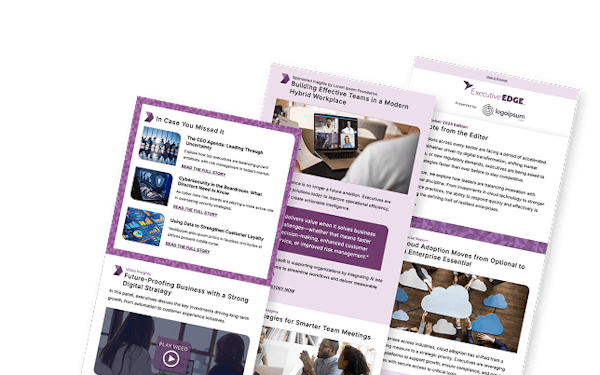
Your Competitive Edge, DeliveredMake smart decisions faster with ExecutiveEDGE’s weekly newsletter. It delivers leadership insights, economic trends, and forward-thinking strategies. Gain perspectives from today’s top business minds and stay informed on innovations shaping tomorrow’s business landscape.